
International Journal of Management Science and Business Administration
Volume 11, Issue 3, March 2025, Pages 7-15
Contemporary Challenges in Public Sector People Management and the Possibilities of New Approaches such as Coaching and Spiritual Quotient (QS)
DOI: 10.18775/ijmsba.1849-5664-5419.2014.113.1001
URL: https://doi.org/10.18775/ijmsba.1849-5664-5419.2014.113.1001
Jefferson Modesto de Oliveira¹, Aylana Cristina Lima de Almeida², Edna Torres de Araujo³
¹ Universidade Federal Rural da Amazônia – UFRA, Belém, Brasil
² Universidade Federal Rural da Amazônia – UFRA, Belém, Brasil
³ Universidade Federal Rural da Amazônia – UFRA, Belém, Brasil
Abstract: People management can be a vital yet challenging component in the administration of any organization. In today’s context—characterized by rapid changes and increasing demands for innovation—the need for approaches that foster human development becomes even more relevant. This article investigates contemporary challenges in public sector people management and discusses how coaching and spiritual intelligence (Spiritual Quotient - QS) can contribute to building healthier, more productive workplaces. The research adopts a qualitative approach, based on documentary and bibliographic analysis. The snowball sampling method was employed to deepen the investigation into coaching and spiritual intelligence. The inclusion of coaching is grounded in the study by Luz and Oliveira (2020), which identified interest among managers and staff at the Federal Rural University of the Amazon (UFRA) in training aimed at personal and institutional development. The discussion of spiritual intelligence, in turn, is justified by the growing prevalence of approaches that seek to humanize people management and promote organizational policies that enhance well-being and ethical decision-making. The findings suggest that adopting coaching and spiritual intelligence in the public sector can significantly contribute to the development of socioemotional skills and the improvement of organizational performance, enabling more human-centered management aligned with the ethical principles of public institutions. In this way, these approaches prove to be viable alternatives for addressing structural challenges in public sector people management, fostering greater efficiency and innovation in administrative processes.
Keywords: Public sector people management; Coaching; Spiritual Quotient (QS).
1. Introduction
People management has become one of the fundamental elements of organizational performance in an increasingly dynamic and competitive corporate environment. At the same time, it faces challenges in fulfilling its role in developing the workforce of these organizations, whether public or private. In this context, public sector organizations encounter the challenge of replacing bureaucratic, centralized models with more modern approaches that value human capital and encourage motivational and ethical practices among employees. This transition is crucial to increasing efficiency, effectiveness, and ethics in the public sector (Bastos & Loreto, 2023).
In this perspective, there is a growing need for approaches that promote the integral development of employees, especially amid technological and social transformations that demand behavioral and emotional skills. In this scenario, two approaches stand out: coaching and spiritual intelligence (Spiritual Quotient - QS). Both, though stemming from distinct fields, share the goal of enhancing human potential, making them relevant in the current context of people management (Gonçalves & Malagolli, 2018; Fidelis et al., 2022).
Coaching has proven to be an effective tool for professional development, helping individuals achieve their goals through self-awareness and goal alignment. Moreover, coaching goes beyond management techniques, as it promotes a mindset shift that facilitates continuous learning and personal growth (Whitmore, 2017; Stober & Grant, 2010). In parallel, spiritual intelligence in the organizational environment involves the ability to find meaning and purpose at work, enabling leaders to adopt a more compassionate and inspiring leadership style. The combination of these two approaches can offer a holistic view of people management, integrating technical, emotional, and spiritual development (Zohar & Marshall, 2000).
The relevance of this study is reinforced by research indicating the growing interest in approaches that promote human development within organizations. For instance, Luz & Oliveira (2020) demonstrated that managers and employees at the Federal Rural University of the Amazon (UFRA) showed interest in coaching training aimed at personal and organizational development. This trend is not exclusive to Brazil; globally, coaching has been widely adopted in public and private institutions as a strategy to strengthen leadership and organizational efficiency (Grant, 2017).
Spiritual intelligence, on the other hand, allows leaders to connect more deeply with their values, leading to fairer decisions aligned with collective well-being (Vaughan, 2002). Highlighting coaching and spiritual intelligence as new pathways in people management seeks to go beyond traditional organizational development approaches. While coaching aids in setting and achieving clear goals, spiritual intelligence contributes to ethical discernment and purpose-seeking, creating a synergy that can offer new perspectives for public sector people management (Gonçalves & Malagolli, 2018; Vaughan, 2002).
The literature on people management in the public sector frequently addresses challenges related to administrative rigidity and resistance to organizational innovation. To fulfill its social role and tackle organizational changes, the public sector needs to resemble private organizations as society evolves (Bastos & Loreto, 2023; Quirino et al., 2009). Furthermore, a review of studies indexed in the SCOPUS and Web of Science databases over the past 25 years—using the terms "Coaching in public administration" OR "Public sector coaching" AND "Spiritual Intelligence" OR "Spiritual Quotient"—reveals a scarcity of research investigating the adoption of coaching and spiritual intelligence as applicable approaches to public sector people management. Although QS was introduced by Zohar and Marshall (Spiritual Intelligence: The Ultimate Intelligence, 2000) and later expanded in Spiritual Capital: Wealth We Can Live By (Zohar & Marshall, 2004), there remains a gap in the literature exploring the synergy between these approaches in public institutions.
The existing studies primarily focus on each approach independently, as highlighted in the studies by Brandes & Lai, 2022; Fidelis et al (2022), Passos et al (2024), Luz & Oliveira, (2020) e Mato Grosso (2017).. Consequently, there is an absence in the literature that investigates how coaching and spiritual intelligence can be adopted in public sector people management.
Therefore, this article aims to provide public managers with alternative approaches to people management in public organizations, focusing on innovation and ethics in the integral development of employees. Simultaneously, it seeks to foster discussions within the scientific literature on these themes to address the following question: What challenges are faced by people management in the public sector, and how can coaching and spiritual intelligence approaches help overcome these challenges?
2.Literature review
2.1 Challenges of People Management in the Public Sector
People management in the public sector faces significant challenges, particularly due to the need to balance bureaucratic structures, efficiency, and the valorization of human capital. The rigidity of administrative processes, the difficulty in implementing innovative policies, and the lack of flexibility in hiring practices are factors that constrain both the development of public servants and the modernization of public administration (Bastos & Loreto, 2023). Additionally, managerial turnover and the influence of political appointments in leadership positions hinder the continuity of strategic projects, compromising the effectiveness of public services provided to society (Leal et al., 2022). Given this scenario, it becomes essential to seek alternatives that prioritize not only compliance with regulations but also the motivation and development of public servants.
Another major challenge in people management within public administration lies in the need to promote an organizational environment that values meritocracy and the continuous development of civil servants. Many institutions still operate under traditional bureaucratic management models, in which training and human development are not treated as priorities. This approach may lead to employee demotivation, low productivity, and challenges in retaining highly qualified talent, directly affecting the efficiency of public administration (Gaia & Silva, 2024).
Furthermore, resistance to change and the need to adapt to evolving technological demands represent additional challenges for people management in the public sector (Marques et al., 2014). The rapid transformations in the labor market require public servants to acquire new skills and adapt to more agile and innovative organizational models (Bastos & Loreto, 2023). Thus, for people management in the public sector to become more efficient and aligned with contemporary needs, it is crucial that public institutions adopt new approaches that foster the appreciation of public servants, encourage administrative innovation, and create a more motivating and productive work environment (Santana et al., 2024).
In this regard, modernization requires the adoption of innovative strategies that promote the holistic development of public servants, moving beyond conventional practices (Santana et al., 2024). In this context, coaching and Spiritual Quotient (QS) emerge as promising alternatives for enhancing motivation, engagement, efficiency, and a sense of purpose within the organizational environment (Gonçalves & Malagolli, 2018; Fidelis et al., 2022). Coaching, by focusing on competency development and the alignment of goals with individual and institutional values, assists public servants in strengthening essential skills to navigate daily challenges and improve professional performance (Luz & Oliveira, 2020). Similarly, Spiritual Quotient (QS) contributes to more human-centered management by fostering reflection on purpose, ethics, and well-being in the workplace (Zohar & Marshall, 2000; Fidelis et al., 2022). By integrating these approaches, public administration can foster a more dynamic, innovative, and people-centered organizational culture, leading to higher job satisfaction among public servants and improved service delivery to society (Gonçalves & Malagolli, 2018; Fidelis et al., 2022).
2.2 Origin of Coaching
Coaching is an approach that originated from various disciplines, such as psychology, sports, and personal development, formally emerging in the 1970s and 1980s. The practice aims to facilitate personal and professional growth, enabling individuals to achieve their goals through self-awareness and self-exploration. In this context, coaching becomes a process that involves the art of evoking excellence in the client/coachee, focusing on performance improvement and goal achievement (Cavanagh, 2006).
Executive coaching, in particular, has gained prominence in recent decades as an essential tool for the development of leaders and managers (Farias, 2014; Gallwey, 2016). Furthermore, coaching can also be seen as a process that not only focuses on goals but also considers the client’s experience and learning capacity, emphasizing the importance of the "how" in achieving objectives (Whitmore, 2017). Therefore, the coaching process aims to guide individuals from their current state to their desired state and involves two key actors: the coachee, who seeks to achieve a specific goal or outcome; and the coach, who is responsible for leading the process through techniques and tools (Luz & Oliveira, 2020). Figure 1 below illustrates the main stages of the coaching process, highlighting the relationship between the coach and the coachee in the pursuit of professional and personal development.
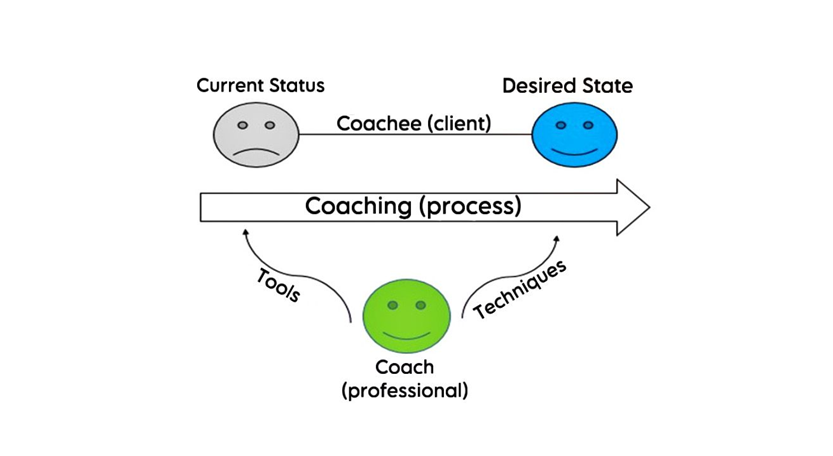
Figure 1. Theprocess of coaching
Source: Adapted from Luz & Oliveira (2020).
Thus, upon analyzing Figure 1, it can be inferred that the coaching process can be understood as a structured journey in which the individual (coachee) receives support to achieve specific goals, develop skills, and overcome challenges. This process takes place through guided interactions with the coach, who employs techniques and tools to stimulate self-reflection and continuous learning (Luz & Oliveira, 2020).
2.3 Perspectives on Coaching
The literature on coaching also highlights its relevance in different contexts, including corporate, sports, and educational environments. Corporate coaching is widely recognized for its ability to enhance organizational effectiveness and leadership development. It is also suggested that coaching can be an effective tool for increasing employee engagement and satisfaction, positively impacting organizational performance (Stober & Grant, 2010).
Understanding the coaching process and its proper application is crucial for achieving results, as well as recognizing how coachees can help individuals overcome internal and external barriers, fostering self-reflection and personal growth (Miller, 2014). Furthermore, the integration of emotional aspects into coaching is an expanding field. In this regard, emotional intelligence is also mentioned as a key component for coaching success, as it enables individuals to connect with their own emotions and those of others, contributing to the development of healthier relationships (Goleman, 1996).
2.4 Coaching and the Public Sector
The coaching process applied to public organizations, despite challenges and resistance, is understood as a strategic tool that can contribute to the development of competencies in public management as well as to individual and collective improvement (Santos et al., 2025).
Educational institutions, like other public sector entities, must respond to social demands and adapt to the transformations of the knowledge era. This requires institutional actors to make decisions quickly and in alignment with these changes (Orozco, 2020).
The elements that constitute coaching techniques can not only enhance individual skills, such as leadership development and emotional intelligence, but also contribute to a more productive organizational climate by encouraging feedback, continuous improvement, and greater commitment to organizational objectives (Sousa & Nogueira, 2020). In this regard, when applied to the educational environment, coaching can serve as a mechanism for fostering personal growth, ultimately leading to the development of essential competencies for the knowledge society (Orozco, 2020).
2.5 New Approaches to Coaching
From a more recent perspective, the literature has explored integrative approaches that combine coaching with other paradigms of personal development. For example, the research by Torresan, Pessoto, and Bueno (2018) discusses the fusion of coaching and mindfulness, suggesting that mindfulness practices can enhance coaching effectiveness by helping clients focus on the present and develop greater self-awareness.
Moreover, the growing attention to diversity and inclusion in coaching is also a relevant topic, as coaching should be adapted to the specific needs of individuals from different cultural backgrounds, fostering a more inclusive and equitable learning environment. These approaches illustrate the evolution of coaching, demonstrating its flexibility and ability to adapt to clients' needs in a constantly changing world (Miller, 2014).
2.6 Spiritual Intelligence: Origin, Principles and Importance for People Management
2.6.1 Origin of Spiritual Intelligence
Spiritual intelligence, also known as Spiritual Quotient (QS), is a concept that has emerged in recent decades, popularized by the works of Zohar and Marshall (2000). They define spiritual intelligence as the ability to find meaning and purpose in life, which can be crucial for human and organizational development. This form of intelligence goes beyond logic and reason, encompassing emotional, ethical, and spiritual aspects, allowing individuals and leaders to make choices that align with their deepest values (Zohar & Marshall, 2000; Fidelis et al., 2022).
2.6.2 Principles of Spiritual Intelligence
Spiritual intelligence (QS) differs from other forms of intelligence as it is related to the ability to find meaning and purpose in life and work (Zohar & Marshall, 2000). According to the authors, individuals with a high spiritual quotient possess skills such as self-awareness, empathy, and a holistic vision, which make them better prepared to handle organizational and personal challenges. In the context of people management, understanding the principles that govern this intelligence can contribute to a more humanized and productive organizational environment (Fidelis et al., 2022). Table 1 below presents the key principles of spiritual intelligence, as described by Zohar and Marshall.
Table 1 – Principles of Spiritual Intelligence (QS)
| Principles | What They Represent |
| Self-Awareness | Understanding oneself and one's beliefs is fundamental for developing spiritual intelligence. This enables individuals to reflect on their experiences and learn from them. |
| Ethics and Values | Decision-making should be guided by ethical principles. Spiritually intelligent leaders promote a culture of integrity and responsibility. |
| Ability to Face and Embrace Diversity | Allows individuals to face life’s challenges with maturity, adopting a positive and learning-oriented perspective. |
| Holistic Perspective | The ability to perceive the bigger picture, not just what is convenient or immediately relevant. It involves a unique perspective on people and their connections. |
| Diversity | Values individuals for their uniqueness, recognizing and respecting differences. |
| Independence | Expresses ideas based on personal principles and values while respecting those of others. |
| Asking "Why?" | Revives a skill commonly used by children, fostering curiosity and encouraging a questioning mindset to understand the reasons behind things, even when answers are complex.
|
| Ability to Consider a Broader Context | Avoids impulsivity. Always seeks to step back and take into account as many variables as possible before making a decision.
|
| Spontaneity | Spiritual intelligence emphasizes the importance of human relationships. Fostering a sense of community within the organization strengthens employee engagement and loyalty. |
| Vocation | Represents a commitment to contributing to society. |
| Humility | Recognizes oneself as a small part of a greater whole. |
| Empathy and Compassion | The ability to put oneself in another’s place is essential. Leaders who practice empathy create a more inclusive and collaborative work environment. |
Source: Prepared by the authors based on the concepts of Zohar & Marshall (2000).
Based on these principles of spiritual intelligence, Upadhyay & Upadhyay (2016) propose a decision-making framework using the Analytic Hierarchy Process (AHP) to measure the spiritual intelligence of university professors. The authors emphasize that spiritual intelligence is not limited to self-reflection but also involves skills such as field independence, the ability to restructure, and the positive use of adversity, enabling individuals to face challenges in a more resilient and creative manner. Additionally, the celebration of diversity and a sense of vocation are highlighted as fundamental components for creating a more harmonious organizational environment aligned with collective values. These elements are essential for leaders and managers in the public sector, as they contribute to building a more inclusive organizational culture focused on the well-being of public servants (Upadhyay & Upadhyay, 2016).
In this context, spiritual intelligence, by integrating attributes such as humility, compassion, and a tendency to question the purpose of actions, fosters a broader perspective on organizational challenges. The research by Upadhyay & Upadhyay (2016) suggests that professionals with a high Spiritual Quotient (QS) demonstrate greater decision-making capacity in complex contexts, as they develop a more holistic and ethical mindset. These characteristics can be particularly relevant in public service, where the need for transformational leadership and principled decision-making is essential. Thus, by considering these principles in people management, it is possible to create environments that promote not only administrative efficiency but also human and institutional growth (Zohar & Marshall, 2004; Upadhyay & Upadhyay, 2016; Fidelis et al., 2022).
2.6.3 Importance for People Management
In people management, spiritual intelligence can be a valuable asset, as it contributes to the creation of work environments that prioritize empathy, collaboration, and justice. Leaders who incorporate spiritual intelligence into their practices tend to be more compassionate and inspiring, fostering a positive organizational climate that enhances engagement and job satisfaction among team members (Latha & Mohanty, 2021). The ability to connect employees to a greater purpose not only increases motivation but also strengthens team cohesion and organizational effectiveness (Zohar & Marshall, 2004).
Furthermore, organizations that recognize the importance of spiritual intelligence in their people management policies are more likely to implement practices that foster the holistic development of their employees, resulting in higher talent retention and increased innovation (Fidelis et al., 2022).
2.6.4 Approaches to Coaching and Spiritual Intelligence in Organizations
The application of coaching and spiritual intelligence in both public and private organizations has proven to be an effective strategy for leadership and team development. Various institutions have adopted these trends to enhance organizational performance and employee satisfaction (Fidelis et al., 2022; Luz & Oliveira, 2020; Latha & Mohanty, 2021; Passos et al., 2024). In the public sector, this application is still evolving, but existing experiences demonstrate its feasibility. Table 2 below presents examples of institutions that have implemented these practices and the observed results in their respective contexts.
Table 2 – Institutions That Have Approached Coaching and Spiritual Intelligence
| Institution | How It Was Approached |
| Hospital Units | The study by Fidelis et al. (2022) concluded that, based on the collected sample, it is possible to infer that the spiritual intelligence of leaders influences work readjustment within their teams, both in Brazil and Portugal. |
| Furnas do Dionísio Community in Jaraguari – MS, Brazil | The research identified that interviewed participants in the community exhibited a high level of spiritual intelligence, which enabled them to transform their reality in the face of challenges (Passos et al., 2024). |
| Federal Rural University of the Amazon (UFRA) | 84% of respondents from UFRA expressed interest in a study that introduced the performance coaching training approach for managers and public servants working in people management (Luz & Oliveira, 2020). |
| Government of the State of Mato Grosso (Brazil) | Through Decree 1065/2017, the Leadership and Coaching Program was established within the Executive Branch (Mato Grosso, 2017). |
| Higher Education Institutions (HEIs) in Bangalore, India | A study conducted with faculty members from HEIs in India revealed that an increase in QS levels can boost employee engagement by up to 29%, fostering a healthier and more productive work environment (Latha & Mohanty, 2021). Factors such as self-awareness, value clarity, and empathy were identified as essential for shaping an organizational culture aligned with employee well-being and institutional efficiency. |
| Independent Coaches Associated with Coaching Organizations in Germany | A qualitative approach based on critical realism and abductive methodology was adopted, using semi-structured interviews with 21 business coaches. Participants were selected based on criteria such as aminimum of two years of experience as external coaches for organizations in Germany and official listing in coaching associations. The study argues that resistance to change should not be seen merely as an obstacle but as a natural emotional response that can be managed constructively. It identifies methods that coaches use to interpret and mitigate this resistance through personalized strategies and effective interpersonal interactions (Brandes & Lai, 2022). |
Source: Prepared by the authors based on the studies conducted by Brandes & Lai (2022), Fidelis et al. (2022), Passos et al. (2024), Luz & Oliveira (2020) and Mato Grosso (2017).
3. Methodology
This study employs a qualitative approach aimed at exploring the use of Coaching and Spiritual Intelligence (QS) approaches in people management within the public sector. The research is based on documentary and bibliographic analysis, combined with non-probability sampling using the snowball sampling method, which allows for the progressive identification of relevant sources on the topic (Naderifar, Goli, & Ghaljaie, 2017).
3.1 Data Collection Procedures
The data were collected from three main sources:
- Academic documentation: A literature review was conducted in indexed databases, including SCOPUS, Web of Science and CAPES Journals (Brazil), using the descriptors: "Coaching in public administration" OR "Public sector coaching" AND "Spiritual Intelligence" OR "Spiritual Quotient".
- Experience reports and case studies:Research and publications on Coaching and Spiritual Intelligence (SQ) practices applied to the development of managers and workers in both the public and private sectors were identified, expanding the scope of the review and enabling a broader understanding of the topic.
- Snowball sampling: To enhance the selection of sources, the snowball sampling technique was employed, in which the initial studies served as a reference for the progressive inclusion of new works and relevant authors. This method allowed for a continuous mapping of the available literature, avoiding biases and promoting a more comprehensive analysis (Naderifar, Goli, & Ghaljaie, 2017).
3.2. Selection Criteria and Data Analysis
The criteria for including sources in the analysis were:
- Publications from the last 25 years (2000-2024), considering the introduction of Spiritual Intelligence by Zohar and Marshall (2000);
- Peer-reviewed studies indexed in recognized databases (SCOPUS, Web of Science, and CAPES Journals);
- Works addressing Coaching and Spiritual Intelligence (QS) in organizational contexts, with potential application to the public sector;
- Empirical and theoretical studies discussing the development of managerial competencies, innovation in people management, and human-centered leadership practices.
The data analysis followed the thematic analysis technique, allowing the identification of conceptual patterns, gaps in the literature, and emerging trends in the use of Coaching and Spiritual Intelligence (QS) in public management. This method enabled a critical interpretation of the findings, ensuring analytical coherence and theoretical grounding in the discussion of results (Braun & Clarke, 2006).
4. Analysis and Discussion
The challenges faced by people management in public service, along with new approaches such as coaching and spiritual intelligence (QS), can serve as solutions or alternatives for modernizing public administration itself, as well as for implementing new leadership models and organizational development in the public sector. The combination of these two approaches can result in more meaningful and productive organizational environments, where the focus is not only on individual performance but also on collective well-being (Gonçalves & Malagolli, 2018; Fidelis et al., 2022).
4.1 The benefits of integration are characterized as follows:
I - Personal and Professional Development: Coaching, by promoting self-knowledge and self-awareness, can become an effective tool for personal development (Mäkelä et al., 2024). When combined with SQ, it enables individuals not only to achieve their professional goals but also to understand how their actions align with their values and purpose. This process allows them to transcend their previous state, potentially leading to greater job satisfaction and a deeper commitment to the organization (Fidelis et al., 2022).
II - Positive Organizational Culture: An institution that incorporates the principles of spiritual intelligence can foster a more empathetic and collaborative organizational culture. By promoting empathy and a sense of purpose, teams tend to engage more, resulting in better performance and lower employee turnover (Zohar & Marshall, 2004; Fidelis et al., 2022).
III - Transformational Leadership: Leaders who apply coaching and SQ have the potential to become change agents in their organizations. They not only motivate their teams to achieve goals but also inspire a sense of belonging and social responsibility aligned with their principles and values. This leadership style can transform group dynamics, fostering an environment where everyone feels valued, heard, and welcomed (Mäkelä et al., 2024; Gonçalves & Malagolli, 2018; Fidelis et al., 2022; Zohar & Marshall, 2004).
4.2 Challenges of Implementation
Although coaching and spiritual intelligence approaches offer significant benefits for people management in the public sector, their implementation is not without challenges. The main obstacles include cultural resistance, professional training, measurement of results, and bias in assessing positive impact.
I- Cultural resistance: Many organizations are still dominated by traditional paradigms that prioritize institutional results over human development. Resistance to practices that incorporate spirituality may limit the adoption of more holistic approaches to people management. Therefore, it is essential for public institutions to foster a culture that values spirituality and the well-being of employees (Lucas, 2021).
II - Professional training: The effectiveness of coaching depends on the training of the professionals involved. It is essential that coaches and leaders are trained not only in coaching techniques but also in a deep understanding of the principles of spiritual intelligence. Training programs that incorporate these approaches can be a pathway to successful implementation (Luz & Oliveira, 2020; Lucas, 2021).
III - Measurement of results: Another challenge relates to assessing the impact of these approaches in the public sector. While traditional performance metrics focus on productivity and operational efficiency, the effects of coaching and spiritual intelligence are more subjective, making it difficult to measure them using quantitative indicators. Developing evaluation tools that consider not only performance indicators but also employee well-being and satisfaction is essential to validate these approaches (Luz & Oliveira, 2020; Lucas, 2021; Fidelis et al., 2022).
IV - Bias in positive impact: Although coaching and spiritual intelligence are widely recognized as effective approaches for human and organizational development, the literature often presents an optimistic bias, emphasizing only the benefits while neglecting challenges and limitations that may compromise their effectiveness. Many coaching interventions fail due to structural factors, misaligned expectations, and organizational resistance (Kruger & Terblanche, 2024).
4.3 Future Implications
The combination of coaching and spiritual intelligence can open new avenues for research and practical application. Future investigations may explore how different sectors and organizational cultures implement these practices and what specific outcomes can be observed. Furthermore, it is important to examine how emerging technologies, such as artificial intelligence and digital platforms, can be utilized to facilitate coaching and promote SQ in organizational environments, whether public or private (Luz & Oliveira, 2020; Mäkelä et al., 2024; Gonçalves & Malagolli, 2018; Fidelis et al., 2022).
5. Final Considerations
The challenges faced by people management in the public sector, combined with the need to modernize public administration, create opportunities for the adoption of new approaches, such as coaching and spiritual intelligence. These methodologies have been discussed in the literature as promising strategies for human and organizational development, albeit in an incipient manner (Fidelis et al., 2022; Grant, 2017; Gonçalves & Malagolli, 2018; Zohar & Marshall, 2004).
This study aimed to answer the following question: What are the challenges faced by people management in the public sector, and how can coaching and spiritual intelligence approaches help overcome these challenges? The findings indicate that, in addition to bureaucratic rigidity and resistance to innovation, there is a gap in the implementation of policies that value the human development of public servants (Bastos & Loreto, 2023). Given this scenario, it was found that coaching can be a strategic tool to strengthen socio-emotional skills and promote alignment between individual and organizational goals (Whitmore, 2017; Luz & Oliveira, 2020). Similarly, spiritual intelligence fosters a more ethical and human-centered management approach, encouraging employee engagement and job satisfaction (Fidelis et al., 2022).
Thus, the proposed objectives were achieved, considering that:(I) The main challenges of people management in the public sector were identified, particularly regarding bureaucracy and resistance to innovation;(II) The benefits of coaching and spiritual intelligence were analyzed as approaches capable of promoting greater efficiency and quality in people management; and(III) It was demonstrated, through institutional examples, that these approaches have already been applied in different organizational contexts.
To further this discussion, future studies are recommended to explore the practical application of these approaches in public institutions using both qualitative and quantitative methodologies. Empirical research could provide a more detailed analysis of the impacts of coaching and spiritual intelligence in public administration, investigating their effects on the development of managers and public servants, institutional efficiency, and the quality of services provided to society. Additionally, comparative studies across different institutions could offer evidence on the feasibility and effectiveness of these practices in various administrative contexts, contributing to the development of more assertive strategies tailored to the realities of the public sector.
In the professional field, this study opens new perspectives for people managers, coaches, leaders, and public servants by providing guidelines for implementing practices that foster the holistic development of work teams. Finally, from a societal perspective, it highlights the possibility of building more humanized work environments that consider the well-being and individual values of public servants. This management model not only positively impacts workers' quality of life but also enhances efficiency and ethics in public administration, resulting in a more human-centered public service aligned with the population’s needs.
References
- Bastos, R. C., & Loreto, M. D. S. (2023). Refletindo a gestão de pessoas no setor público: Um ensaio teórico. Revista Gestão e Secretariado (GeSec), 14(9), 15250-15267. CrossRef
- Brandes, B., & Lai, Y.-L. (2022). Addressing resistance to change through a micro interpersonal lens: An investigation into the coaching process. Journal of Organizational Change Management, 35(3), 666-681. https://doi-org.ez4.periodicos.capes.gov.br/10.1108/JOCM-07-2021-0214
- Braun, V., & Clarke, V. (2006). Using thematic analysis in psychology. Qualitative Research in Psychology, 3(2), 77–101. CrossRef
- Cavanagh, K. (2006). Coaching from the inside: The role of the coach in the coaching process. International Coaching Psychology Review, 1(1), 24-36.
- Farias, C. (2014). Como formar profissionais da área de gestão com foco em coaching. In A. Roma et al. (Eds.), Coaching para gestão de pessoas: Como formar profissionais da área de desenvolvimento e gestão com foco nas habilidades do coaching (pp. 57-63). Editora Leader.
- Fidelis, A., Formiga, N., & Fernandes, A. J. (2022). A inteligência espiritual e reajuste do trabalho em brasileiros e portugueses de unidades hospitalares. RECIMA21 - Revista Científica Multidisciplinar, 3(4), e341382. CrossRef
- Gaia, A. R., & Silva, C. L. da. (2024). Governança e gestão de pessoas na administração pública: Avanços para a gestão de pessoas. Revista de Gestão e Secretariado (GeSec), 15(5), 1-16. CrossRef
- Gallwey, W. T. (2016). O jogo interior do tênis: O guia clássico mental da excelência no desempenho.
- Goleman, D. (1996). Inteligência emocional: A teoria revolucionária que redefine o que é ser inteligente (10ª ed.). Objetiva.
- Gonçalves, J. L., & Malagolli, G. A. (2023). O coaching como estratégia de aumento do desempenho do capital humano nas organizações. Infarma – Ciências Farmacêuticas, 15(2). CrossRef
- Grant, A. M. (2017). The third generation of workplace coaching: Creating a culture of quality conversations. Coaching: An International Journal of Theory, Research and Practice, 10(1), 37-53.
- Kruger, F., & Terblanche, N. H. D. (2024). The coaching flipside: Factors underlying unsuccessful workplace coaching interventions and the implication for human resource development. Human Resource Development Quarterly.CrossRef
- Latha, G., & Mohanty, S. (2021). Influence of spiritual quotient on employee engagement: A study on higher education institutions in Bangalore, India. Ilkogretim Online - Elementary Education Online, 20(6), 1199-1208. CrossRef
- Leal, G. E. F., Lima Filho, J. S. F. de, Araújo, E. F. de, & Paulo, N. L. (2022). Gestão de recursos humanos no setor público. Id on Line Revista de Psicologia, 16(61), 282-295. CrossRef
- Lucas, J. M. Q. (2021). Espiritualidade e cultura organizacional: Um estudo de caso na Faculdade Imaculada Conceição do Recife-PE. Métodos e Pesquisa em Administração, 6(1), 16-29. CrossRef
- Luz, C. D., & Oliveira, J. M. de. (2020). O processo de coaching de performance para uma universidade pública da Amazônia: uma perspectiva para o desenvolvimento de gestores e servidores da área de gestão depessoas.RevistaUNIFAMMA,19(2).Disponívelem https://revista.famma.br/index.php/revistaunifamma/article/view/27
- Naderifar, M., Goli, H., & Ghaljaie, F. (2017). Snowball sampling: A purposeful method of sampling in qualitative research. Strides in Development of Medical Education, 14(3), e67670. CrossRef
- Mäkelä, L., Kangas, H., Korkiakangas, E., & Laitinen, J. (2024). Coaching leadership as a link between individual- and team-level strength use at work. Cogent Business & Management, 11(1), 2293469. CrossRef
- Marques, A. L., Borges, R., Morais, K., & Silva, M. C. (2014). Relações entre resistência à mudança e comprometimento organizacional em servidores públicos de Minas Gerais. Revista de Administração Contemporânea, 18(2), 161-175. CrossRef
- Mato Grosso. (2017). Decreto nº 1.065, de 27 de junho de 2017. Institui o Programa de Liderança e Coaching no âmbito do Poder Executivo Estadual. Disponível em https://leisestaduais.com.br/mt/decreto-n-1065-2017-mato-grosso-institui-o-programa-de-lideranca-e-coaching-no-ambito-do-poder-executivo-estadual-e-da-outras-providencias
- Miller, Y. (2014). Coaching para uma gestão humanizada. In A. Roma et al. (Eds.), Coaching para gestão de pessoas: Como formar profissionais da área de desenvolvimento e gestão com foco nas habilidades do coaching (pp. 165-172). Editora Leader.
- Orozco, E. A. (2020). Un proyecto para trabajar la inteligencia espiritual a través de coaching. Revista de Ciencias de la Comunicación e Información, 25(2), 91-105.CrossRef
- Passos, T. D. dos, Sales, A., Ramalho, D. G., & Damke, L. B. (2022). Spiritual intelligence evaluation in Furnas do Dionísio community in Jaraguari - MS. Research, Society and Development, 11(15), e43111536537. CrossRef
- Quirino, S. G., Faria, A. C. de, & Barros, D. F. (2009). Gestão de pessoas nas prefeituras de médio porte da Zona da Mata do Estado de Minas Gerais: A perspectiva de agentes políticos [Dissertação de mestrado, Universidade Federal de Viçosa]. Universidade Federal de Viçosa. Disponível em http://locus.ufv.br/handle/123456789/1927
- Santana, D. F., Gomes, E. C., & Nobre, C. K. (2024). Gestão de pessoas no setor público: Impactos do processo de qualificação no desempenho das atividades de atendimento dos servidores públicos. Revista Foco & Transformação. Disponível em https://revistaft.com.br/gestao-de-pessoas-no-setor-publico-impactos-do-processo-de-qualificacao-no-desempenho-das-atividades-de-atendimento-dos-servidores-publicos/
- Santos, F. P., Siqueira, E. G. Q., Ramos, K. J. A. M., & Nascimento Jr., O. R. (2020). O coaching como ferramenta para desenvolver competências: Um estudo de caso na Secretaria de Planejamento do Estado de Alagoas - SEPLAG. Revista Estudos e Pesquisas em Administração, 4(2), 24–41. CrossRef
- Sousa, M. R., & Nogueira, Í. C. S. (2020). Os estilos de liderança e as ações de coaching em uma empresa pública da cidade de Goiânia. Brazilian Journal of Development, 6(6), 40077-40095. CrossRef
- Stober, D. R., & Grant, A. M. (2010). Evidence-based coaching handbook: Putting best practices to work for your clients. John Wiley & Sons.
- Torresan, M. L., Pessotto, F., & Bueno, C. H. (2018). Mindfulness e coaching: Alternativas para o desenvolvimento humano. Revista de Carreira de Pessoas, 8(1), 1-15. CrossRef
- Upadhyaya, S., & Upadhyay, N. (2016). A multi-criteria decision framework to measure spiritual intelligence of university teachers. Procedia Computer Science, 91, 591-598. CrossRef
- Vaughan, F. (2002). What is spiritual intelligence? Journal of Humanistic Psychology, 42(2), 16-33. CrossRef
- Zohar, D., & Marshall, I. (2000). Spiritual intelligence: The ultimate intelligence. Bloomsbury Publishing.
- Zohar, D., & Marshall, I. (2004). Spiritual capital: Wealth we can live by. Berrett-Koehler Publishers.
- Whitmore, J.(2017). Coaching for performance: The principles and practice of coaching and leadership (5ª ed.). Nicholas Brealey Publishing.


