
International Journal of Innovation and Economic Development
Volume 11, Issue 6, February 2026, Pages 28-61
Navigating the Marketing Future (2025–2030): Integrating the BRAVE Taxonomy with Agent-Based Modelling
URL: https://doi.org/10.18775/ijied.1849-7551-7020.2015.116.2002
DOI: 10.18775/ijied.1849-7551-7020.2015.116.2002
Suresh Sood 1,2
1Industry/Professional Fellow in the Australian Artificial Intelligence Institute (AAII), University of Technology Sydney
2Adjunct Fellow, Frontier AI Research Centre, Macquarie University, Sydney)
Abstract: The marketing profession is undergoing structural transformation driven by emerging technologies, shifting societal expectations, and the erosion of traditional transactional models. This article introduces the BRAVE taxonomy comprising Blockchain, Robotics, Artificial Intelligence, Vital Infrastructure, and Environmental technologies as a framework for organizing emerging technological domains and mapping implications for future marketing roles. Drawing on leading global foresight sources, the taxonomy consolidates fragmented technological trends into five capability-based domains to support workforce strategy and organizational design.
To explore how these technologies reshape marketing teams, the study integrates the BRAVE taxonomy with Agent-Based Modelling (ABM). The model simulates a stylized 2025–2030 marketing ecosystem with marketing role-representing agents interacting under specified assumptions regarding productivity growth, return on investment (ROI), and societal impact. The simulation does not generate empirical forecasts but rather, provides scenario-based insights into how different technological capability clusters influence marketing role evolution, team composition, and aggregate performance outcomes over time.
Results illustrate how leadership roles (e.g., Chief AI Marketing Strategist, Sustainability Marketing Director) and functional specialists (e.g., Blockchain Loyalty Program Manager, Edge Data Marketing Analyst) contribute differently to simulated productivity and ROI trajectories over the time of the study. The modelling further demonstrates how technology-aligned roles may influence broader societal impact indicators under varying adoption scenarios.
By combining taxonomy development with computational simulation, this study offers both a conceptual classification framework and a methodological tool for scenario testing. The approach provides marketing leaders with a structured approach to workforce planning under technological uncertainty and contributes to macromarketing scholarship by linking emerging technologies, organizational role design, and societal impact within an integrated analytical framework.
Keywords: BRAVE taxonomy; Agent Based Modelling; Workforce/role design; Societal impact/macromarketing
1. Introduction
Marketing towards 2030 is increasingly unrecognizable driven by the convergence of BRAVE and data analytics empowering strategies to address societal and environmental challenges. This research explores how the BRAVE taxonomy comprising categories of Blockchain, Robotics, Artificial Intelligence, Vital Infrastructure, and Environmental technologies are reshaping the marketing profession, skill requirements, and the future of marketing work. The methodology to develop the taxonomy integrates insights on emerging technologies from authoritative sources. The Agent-Based Model (ABM)[1] provides actionable insights for workforce transformation in the marketing sector towards 2030 while answering the question: How can organizations build the marketing teams of tomorrow? In this simulation study, “agents” refer to role-representing entities within an ABM used for simulation purposes.
2. Literature Review
The literature on building a taxonomy of emerging technologies and roles for future marketing teams, particularly in the context of ABM, reveals several gaps. These gaps pertain to the integration of emerging technologies with marketing roles, the development of comprehensive taxonomies, and the application of ABM in future marketing workforce development. The integration of ABM with the exploration of future marketing roles is in a nascent stage, and the need exists for a comprehensive framework capable of guiding the development of future workforce marketing teams. The following sections outline the key gaps identified in literature before satisfactorily envisaging the marketing team of 2030.
Firstly, a notable absence exists of a major or overarching framework integrating ABM with a structured taxonomy of marketing roles. While ABM has been explored in various domains, the application in marketing, particularly in defining future roles and responsibilities is limited (Bukhsh et al., 2024; Cross et al., 2023). Surprisingly, empirical case studies validating the effectiveness of ABM in modelling marketing roles is also not readily available. Most existing research is theoretical or based on simulations without real-world validation (Adriaansen et al., 2013). Case studies, particularly in diverse industries, likely provide valuable insights into how ABM can be applied to understand and optimize marketing roles and team dynamics (Madsen & Rosenbaum, 2018). The literature highlights a gap in understanding how agents can be utilized to organize and execute marketing tasks. The roles of agents in marketing are not well-defined, and a need exists for a finer level of granularity to understand emergent roles (Madsen & Rosenbaum, 2018; Guizzardi, 2006) beyond traditional job titles (McClaren & Shaw, 2003). McAlister et al. identify three types of marketing organizations but do not provide a detailed taxonomy of individual marketing roles within organizations (McAlister et al., 2022). This suggests a further gap in understanding how different roles contribute towards an overall marketing strategy. Developing taxonomies for BRAVE and marketing roles is complex due to the intersection of multiple fields and the current state of knowledge. Existing methodologies require extensions to effectively classify and integrate new technologies into marketing roles (Nickerson et al.,2013; Mwilu et al., 2015). A need exists not only for a systematic classification of digital technologies impacting marketing innovations but a need for a taxonomy considerate of the dynamic nature of marketing roles, especially in the context of evolving BRAVE technologies especially when directly impacting information and communication technology (Madsen & Rosenbaum, 2018). Furthermore, current frameworks do not adequately address the dynamic nature of BRAVE technologies and implications for marketing strategies (Athaide et al., 2024). The integration of AI and digital skills into marketing teams is a significant challenge. While recognition of the importance of these skills is not fully understood, a limited guidance on how to effectively incorporate the skills into existing marketing frameworks is available (Rathore, 2023). The rapid evolution of technologies necessitates continuous updates to taxonomies and frameworks. Existing classification systems are limited in scope and do not capture the full impact of technological advancements on marketing roles (Correia et al., 2018). Validation methods evaluating the performance of ABMs in marketing contexts is left wanting. Improvements in validation techniques are necessary to ensure the reliability and effectiveness of the models (Bukhsh et al., 2024).
While the literature identifies several gaps in the development of taxonomies for emerging technologies and marketing roles, the potential for future research to address these challenges is essential. The integration of ABM with marketing roles offers a promising avenue for developing more effective marketing teams. While ABM has been applied in various fields, use in modelling marketing teams is still emerging. The literature suggests ABM can provide insights into team dynamics and consumer behavior, yet there is a scarcity of studies specifically focusing on marketing teams and their internal role dynamics (Mandel et al., 2013; Rand, 2024). The potential of ABM to simulate the interactions and decision-making processes within marketing teams is not fully realized. Existing models often focus on consumer interactions or product development teams, rather than the specific roles and responsibilities within marketing teams (Crowder et al., 2009; Ivan et al., 2022). However, the dynamic nature of BRAVE technologies and the complexity of integrating them into existing frameworks pose ongoing challenges requiring continuous research and adaptation.
Table 1: Research Gaps and How Addressed
| Research Gap | Description | How This Research Addresses the Gap |
| 1. Lack of integrated ABM–taxonomy frameworks | Absence of framework combining ABM computer simulations with taxonomy of marketing roles. | Proposes the BRAVE Taxonomy mapped onto ABM simulations to forecast marketing role emergence and transitions in marketing teams. |
| 2. Absence of empirical validation in ABM-marketing | ABM use in marketing is theoretical or simulation-based, with few real-world case studies. | Suggests application-based role simulation outputs (ROI, carbon impact, trust levels), allowing testable scenarios and feedback loops. |
| 3. Under specification of ‘agents’ in marketing tasks | Ambiguity remains in how ABM ‘agents’ are mapped to granular marketing activities. | Clearly distinguishes ABM agents from agentic AI workflows, aligning agents with dynamic task roles and simulations of role-based productivity. |
| 4. No taxonomy for emergent roles beyond job titles | Existing studies classify marketers by function, not dynamic interaction or skill clusters. | Introduces BRAVE Marketer typology (e.g., Ecosystem Curator, Trust Builder), allowing for role clustering, not just titles. |
| 5. Fragmentation in digital tech and marketing alignment | Current frameworks fail to classify evolving technologies in relation to marketing roles. | Extends Nickerson et al. design theory to include emerging digital role archetypes influenced by AI, blockchain, and LLMs. |
| 6. Inadequate reflection of BRAVE dimensions | Traditional marketing frameworks ignore BRAVE technologies. | Positions BRAVE as a central organising logic for marketing transformation and taxonomy classification. |
| 7. Limited guidance for AI/digital skill integration | Despite recognizing digital importance, few frameworks guide integration of these skills in teams. | Provides sample role simulations with agentic workflows, highlighting how LLMs, avatars, and tools reshape workflows. |
| 8. Outdated classification systems | Taxonomies are static and not updated to reflect fast-moving tech shifts. | Uses ABM dynamics to continuously simulate role need/decline/emergence based on evolving tech and societal impacts. |
| 9. Weak validation methods in ABM for marketing | ABM validation metrics in marketing are not standardised or robust. | Recommends integrating impact metrics (e.g., ROI, carbon, trust, diversity scores) to validate agent simulations. |
| 10. Lack of focus on team-level marketing ABM | Most ABMs focus on customer or product not internal marketing team dynamics. | Focuses squarely on intra-team dynamics (cross-skilling, role overlap, agent drift) in future-ready marketing teams. |
3. Research Methodology and Results
Integrating BRAVE Taxonomy with Agent Based Modelling
This research employs a novel methodology combining the BRAVE taxonomy (Blockchain, Robotics, Artificial Intelligence, Vital Infrastructure, and Environmental Technologies) of emerging technologies and marketing roles using ABM to explore and predict the evolution of marketing roles and societal impact from 2025 to 2030. The approach systematically generates roles from the BRAVE taxonomy and integrates them directly into an ABM simulation to assess productivity, ROI, and societal impact over time. This section presents the methodology alongside corresponding results allowing readers to immediately see how each step contributes to the outcomes.
3.1. Constructing the BRAVE Taxonomy
The BRAVE taxonomy serves to underpin the foundational proposition for emerging technologies leading to or shaping the creation and evolution of marketing roles. While several emerging technologies such as AI, IoT, blockchain and Metaverse are repeatedly mentioned in articles as having transformative capability a gap exists in no single authoritative listing of emerging technologies is available to marketers. To this end, as a first step to develop the taxonomy, we use a structured process of synthesizing insights from authoritative sources (Table 3) to identify, group, and prioritize technologies resulting in a consolidated list of high-impact technologies relevant to marketing. Our selection of authoritative sources (Table 3) each providing lists of technologies (Appendix A) includes the Gartner Hype Cycle of Emerging Technologies (Gartner 2024), World Economic Forum report of Top 10 Emerging Technologies (World Economic Forum 2024), McKinsey Technology Trends report (McKinsey 2024), MIT Tech Review 10 Breakthrough Technologies (MIT 2024), CB Insights Tech trends (CB Insights 2024), IEEE Spectrum Top Tech 2024 (IEEE 2024), and ARK Invest big Ideas 2024 (Ark 2024). Notable exclusions include vendor or sponsored research to minimise or avoid biases e.g. Marketing 2025 (Marketo). Additionally, the expectation is using annual research reports we ensure terms populating the taxonomy are up to date by ensuring a refresh on a regular basis.
Table 2: List of Authoritative Tech Sources – Available sources, output and accessibility
| Name of Tech source | Available Sources | Relevant Output | How Accessible |
| Gartner Emerging Technology Hype Cycle | Annual report highlights technologies across stages, from early innovation to mainstream adoption. | Key technologies that are either emerging, reaching peak interest, or nearing widespread adoption. | Available through Gartner’s website. Some reports require a subscription. Summaries often appear in Forbes, TechCrunch, or ZDNet. |
| World Economic Forum (WEF) Technology Reports | Insights on technologies impacting global industries, economies, and society, with a focus on sustainability, digital transformation, and AI. | A list of “Top 10 Emerging Technologies” updated annually with explanations on each technology’s impact. | Reports freely available on the WEF website. |
| McKinsey Tech Trends and Reports | Annual insights on digital transformation, AI, automation, and other significant trends. | Technologies reshaping industries like manufacturing, healthcare, and finance. | Available on McKinsey’s website. Key insights often freely accessible. |
| CB Insights Tech Market Maps and Trends | Market research and analytics on emerging technologies like AI, fintech, and digital health. | Lists of up-and-coming technologies, often segmented by industry. | Some free resources available but full access requires subscription. Summaries often covered in tech media. |
| MIT Tech Review of 10 Breakthrough Technologies | Annual list of “10 Breakthrough Technologies” shaping the future. | Emerging technologies with high potential impact in areas like computing, energy, and healthcare. | Available on the MIT Technology Review website and often freely accessible. |
| IEEE Spectrum Technology Forecasts | Covers engineering and tech advancements with insights into current and future tech trends. | Lists and articles on technologies in robotics, AI, IoT, and other high-tech fields. | Available on the IEEE Spectrum website. Some content requires subscription. |
Synthesizing the authoritative sources into a consolidated list of emerging technologies (Appendix A) develops a robust foundation for the BRAVE taxonomy (Table 4) grouping technologies by category (Appendix B).
Taxonomy Development Procedure
To enhance transparency and replicability, the BRAVE taxonomy construction uses a structured five-step process inspired by design-science taxonomy development approaches (Nickerson et al., 2013):
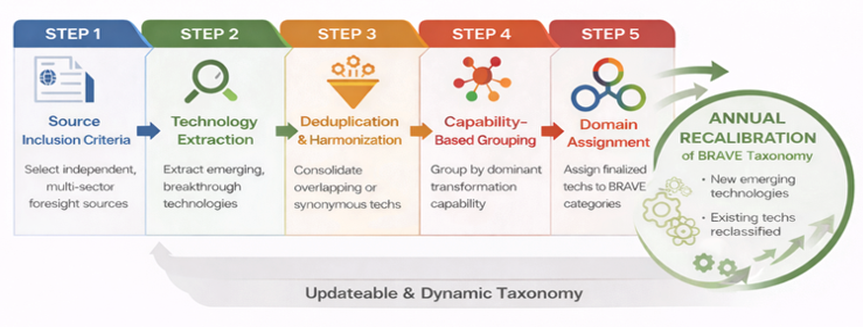
Figure 1: 5 step taxonomy development process
Note: Developed by the author. Conceptual structure informed by Nickerson et al. (2013)
3.1.1. Source Inclusion Criteria & Forecast Aggregation
Only independent, multi-sector foresight reports published in 2024 by globally recognized institutions (e.g., Gartner, WEF, McKinsey, MIT Technology Review, IEEE Spectrum, CB Insights, ARK Invest) are included. Vendor-sponsored or single-firm proprietary reports are excluded to minimize commercial bias. Aggregation of the forecasting is consistent with principles of superforecasting (Tetlock & Gardner, 2015) and the wisdom-of-crowds framework (Surowiecki, 2004), aggregate the independent foresight assessments from the multiple reports. This aggregation minimizes single-source bias and strengthens predictive robustness by identifying convergent technological signals across domains. Rather than relying on one institutional perspective, the BRAVE taxonomy synthesizes recurring technological trajectories appearing across diverse, independently produced foresight reports, thereby increasing methodological transparency and forecast reliability.
3.1.2. Technology Extraction
Technologies explicitly listed as emerging, breakthrough, disruptive or transformative are extracted verbatim from each report.
3.1.3. Deduplication and Harmonization
Merge semantically overlapping technologies (e.g., Generative AI vs. Large Language Models) are consolidated when functional similarity exceeds 70% based on capability descriptions.
3.1.4. Capability-Based Grouping
Technology grouping is not by industry but by dominant capability logic (e.g., decentralization → Blockchain; predictive intelligence → AI; interconnected infrastructure → Vital Infrastructure).
3.1.5.Domain Assignment to BRAVE Categories
Final technologies are assigned to one of five BRAVE domains based on the primary transformation vector:
Trust/Decentralization → Blockchain
Automation/Embodiment → Robotics
Intelligence/Prediction → AI and Machine Learning
Connectivity/Systems → Vital Infrastructure
Sustainability/Regeneration → Environmental
The taxonomy design is updateable on an annual basis or more frequently, enabling dynamic recalibration as new technologies emerge. The recalibration process is an overarching feedback loop.
Table 3: BRAVE Taxonomy of Emerging Technologies by Category
| BRAVE Category | Number of Technologies | Characteristics of Category | Technologies from Authoritative Sources |
| B - Blockchain and Security | 14 | Transparency, decentralization, and secure transactions. | Blockchain, Cryptocurrency, Security Technologies, Privacy Technologies, Bitcoin Allocation, Smart Contracts, Digital Wallets, Homomorphic Encryption, Content credentials for combating deepfakes, Algorithmic video surveillance, Blockchain finserv, Cybersecurity, AI & security, Cyber chaos security consolidation |
| R - Robotics and Automation | 8 | Automation and customer interaction enhancement. | Robotics, Humanoid Working Robots, Robotaxis, Autonomous Logistics, Reusable Rockets, 3D Printing, Electric Vehicles, Humanoid robots |
| A - Artificial Intelligence and Machine Learning | 19 | Predictive analytics, personalization, and decision-making | Artificial Intelligence, AI-Augmented Software Engineering, AI Supercomputing, Generative AI, Applied AI, Large Language Models, AI for scientific discovery, AI weather prediction, AI agent marketplaces, Industrializing Machine Learning, Multimodal AI, Synthetic data, No code software, Bank AI, AI drug discovery, Digital therapeutics, AI sales agents, AI loss prevention, AI gaming |
| V - Vital Infrastructure | 11 | Real-time data exchange and interconnected ecosystems (e.g., IoT, 5G). | Digital Infrastructure, Next-gen Software Development, Cloud and Edge Computing, Immersive Reality Tech (AR/VR), Integrated sensing & communication, High-altitude platform stations, Apple Vision Pro, Quantum computing commercialization, Wi-Fi 7, HVDC networks, Blue PHOLED displays |
| E – Energy, Environment and Health | 18 | Sustainability practices, carbon tracking, and renewable energy. | Sustainable Energy, Electrification, Climate Technologies, Enhanced Geothermal, Super-Efficient Solar Cells, Heat Pumps, Carbon-sequestering kelp, Alternative feeds, Ultra-deep drilling, Advanced nuclear, Genomics, Precision Therapies, Multiomic Tools, Gene Editing, Epigenetic reprogramming, Brain tech, Synchron brain-implant, Extreme weather Insurtech |
The BRAVE taxonomy is grounded in our analysis of emerging technologies drawn from reputable sources (Table 3). Each source has a specific focus on trending and emerging technologies (Table 1). Consistent with “superforecasting” principles and the “wisdom of crowds” (Tetlock & Gardner, 2015; Suroweicki, 2004) we aggregate the credible source lists thus minimising biases and strengthening predictions to generate the BRAVE taxonomy (Table 2). These technologies categorize into five domains comprising the taxonomy based on transformative potential, ensuring the framework reflects impactful innovations for marketing.
3.2. Steps to Generate Roles from Technology
Step A: Define Technology Capabilities
For each category in the BRAVE taxonomy, key technological capabilities are identified. For example:
- Blockchain enables decentralized loyalty programs and secure data management.
- AI facilitates predictive analytics and hyper-personalization.
Step B: Map Capabilities to Marketing Functions
The identified capabilities map to marketing functions such as customer engagement, campaign management, and data analytics. For instance:
- Blockchain aligns with secure advertising and transparency in loyalty programs.
- Robotics (humanoids) integrates into retail automation and scalable operations.
Step C: Identify Role Requirements
Skill sets and responsibilities are outlined for each capability-function pair. This includes:
- Technical Skills include coding for automation of LLM (large language models) workflow, understanding blockchain protocols.
- Strategic Thinking for Integrating technology into marketing strategies.
- Soft Skills requires Collaboration, ethical decision-making, and creativity.
Step D: Formulate Roles
Distinct roles are created by integrating technological functionalities with marketing principles. Examples include:
- Blockchain Trust Manager: Oversees transparent loyalty programs.
- Predictive Marketing Analyst: Applies AI for consumer targeting.
 Figure 2: BRAVE Taxonomy Leadership and Functional Marketing Roles
Table 4: Key Marketing Leadership & Functional Roles (2025-30)
| ID | Leadership or Functional Role | Purpose | Key Responsibilities | BRAVE Technologies | Comments |
| 1 | Chief AI Marketing Strategist | Drive AI adoption in marketing strategies, ensuring campaigns are data-driven and predictive. | - Oversee AI-driven customer journey mapping and real-time personalization.
- Develop ethical AI guidelines for marketing. - Leverage generative AI for content creation, campaign simulations, and audience segmentation. |
AI, Blockchain | AI ensures predictive personalization; Blockchain enables secure handling of consumer data for ethical marketing initiatives. |
| 2 | Virtual Brand Experience Architect | Create immersive and interactive brand experiences in the metaverse and virtual environments. | - Design virtual stores, events, and experiences that integrate with physical campaigns.
- Collaborate with product teams to create digital twins for testing and marketing. - Measure and analyze virtual engagement metrics. |
AI, Vital Infrastructure (AR/VR) | Combines AR/VR tools with AI to deliver measurable, immersive brand experiences. |
| 3 | Sustainability Marketing Director | Align marketing strategies with sustainability goals and ESG (Environmental, Social, Governance) metrics. | - Craft campaigns showcasing sustainable practices and achievements.
- Collaborate with supply chain and product teams to certify green initiatives. - Use carbon credit data to demonstrate a product's sustainability impact. |
Blockchain, Environmental Technologies | Blockchain ensures transparency in green certifications, while environmental technologies measure carbon credits and sustainability impact. |
| 4 | Generative Content Innovator | Leverage AI to generate creative, adaptive, and personalized marketing content at scale. | - Manage AI tools for producing video, audio, text, and AR/VR content.
- Create hyper-personalized content based on customer data and preferences. - Continuously iterate campaigns using AI-generated insights. |
AI, Vital Infrastructure (AR/VR) | AI drives scalable content creation; AR/VR ensures immersive and engaging experiences. |
| 5 | Predictive Marketing Analyst | Use predictive analytics to anticipate market trends and consumer behavior. | - Analyze data to identify emerging trends and growth opportunities.
- Develop actionable insights for proactive campaign adjustments. - Collaborate with AI teams to train predictive models. |
AI, Vital Infrastructure | AI ensures accurate forecasting and analysis; vital infrastructure supports large-scale analytics. |
| 6 | Ethical Marketing Compliance Officer | Ensure all marketing campaigns and initiatives adhere to ethical guidelines and avoid misleading or manipulative practices. | -Monitor AI-driven campaigns for ethical adherence.-Audit ad targeting mechanisms for fairness and transparency.
-Build consumer trust through transparency and accountability in marketing. |
Blockchain, AI | AI automates ethical checks; Blockchain provides immutable proof of ethical campaign practices. |
Emerging technologies redefine marketing capabilities and create new, specialized marketing roles (Table 5). From neuromarketing analysts and quantum strategists to holographic designers and blockchain loyalty managers, these roles represent the intersection of technological advancement and human expertise (ibid). Together, they form the foundation of a marketing workforce equipped to navigate the challenges and opportunities of 2030. As marketing continues the journey into a technologically sophisticated future, the rise of advanced tools including neuromarketing, quantum computing, and digital twin technology is profoundly set to impact the workforce.
Table 5: Specialist Marketing Roles – Technology, Role & Capabilities
| Technology | Role | Capabilities |
| Neuromarketing Technologies | Neuromarketing Analyst | Measures subconscious consumer preferences, enhances campaigns by analyzing emotional and cognitive responses. Moves towards “mind reading” consumers. |
| Behavioral Insights Specialist | Translates neuromarketing data into actionable strategies, aligning brand messaging with psychological triggers. | |
| Quantum Computing | Quantum Marketing Strategist | Real-time optimization of multi-channel campaigns, ensuring efficient ad spend and timing. |
| Quantum Data Scientist | Unlocks consumer insights and predicts trends using quantum-driven models. | |
| Digital Twin Technology | Digital Twin Marketing Manager | Simulates marketing strategies to predict outcomes and reduce risks. |
| Virtual Experience Designer | Creates realistic customer journeys, refining strategies for specific audiences. | |
| Holographic Displays | Holographic Campaign Designer | Replaces static ads with interactive 3D holograms, creating immersive consumer experiences. |
| Spatial Interaction Specialist | Optimizes usability and navigation in holographic marketing displays. | |
| Autonomous Agents and Chatbots | Conversational AI Specialist | Provides 24/7 personalized customer support using NLP. |
| Virtual Sales Representative | Automates pre-sales consultations and product recommendations, enhancing engagement. | |
| Blockchain-Powered Loyalty | Blockchain Loyalty Program Manager | Designs tamper-proof, decentralized loyalty systems that build trust. |
| Cryptographic Marketer | Attracts tech-savvy consumers with tokenized rewards and integrates blockchain into campaigns. | |
| Voice Commerce Platforms | Voice Commerce Specialist | Optimizes brand discoverability through voice assistants and natural language queries. |
| Conversational UX Designer | Designs seamless voice interactions for improved customer retention. | |
| Gamification Platforms | Gamification Marketing Designer | Builds interactive, game-like campaigns to boost engagement and loyalty. |
| Interactive Campaign Analyst | Measures and optimizes gamified initiatives for higher ROI. | |
| 5G and IoT-Enhanced Marketing | Real-Time Marketing Coordinator | Delivers ultra-responsive campaigns based on IoT data and 5G connectivity. |
| IoT Integration Specialist | Integrates IoT devices into campaigns, gathering data for personalization. | |
| Edge Computing | Edge Data Marketing Analyst | Processes real-time consumer data to deliver instant, personalized ads. |
| Dynamic Campaign Strategist | Dynamically optimizes marketing strategies based on real-time data for improved ROI. |
3.3. Linking the BRAVE Taxonomy to Agent-Based Model Parameterization
The BRAVE taxonomy does not function solely as a classification approach. The taxonomy provides the structural basis for parameterizing the Agent-Based Model (ABM). Each BRAVE domain corresponds to a capability logic informing agent attributes within the simulation. For example, technologies grouped under Artificial Intelligence inform productivity growth rates and adaptive capacity parameters, while Blockchain influences transparency coefficients and trust-related societal impact variables. Environmental technologies inform sustainability impact weights, and Vital Infrastructure contributes to connectivity multipliers affecting system-level efficiency. In this way, the taxonomy serves as the conceptual translation layer between foresight analysis and computational modelling. Rather than assigning arbitrary simulation parameters, agent attributes are grounded in structured technological capability domains derived from the taxonomy. This linkage ensures theoretical coherence between classification logic and simulating role behavior across the 2025–2030-time horizon.
By combining the BRAVE taxonomy with ABM, the methodology offers a structured approach to explore the future of marketing roles. The dynamic simulation enables organizations to:
- Identify high-impact roles for investment.
- Align workforce strategies with emerging technologies.
- Assess the societal implications of marketing activities.
This method bridges technological innovation with strategic workforce planning, advancing both organizational goals and societal well-being. Combining Python Mesa (Kazil et al., 2020), a framework for building, analyzing and visualizing ABM and the BRAVE taxonomy, researchers can simulate and analyze potential future scenarios in the marketing domain. Agents represent future marketing leadership and functional roles linking directly back to BRAVE technologies. The Mesa platform (ibid) simplifies the construction and management of complex systems of agents representing distinct roles, behaviors, and interactions within a marketing ecosystem. The agents are informed by the structured categories of the BRAVE taxonomy (Blockchain, Robotics, AI, Vital Infrastructure, and Environmental Technologies) and are programmable to adapt dynamically to external and internal stimuli over time.
Using Python Mesa, agents are imbued with attributes of productivity levels, growth potential, ROI factors, and external influences like adaptability to market trends or technological shifts. Through iterative simulation steps representing months (or years), the model tracks changes in the agent attributes, uncover emergent patterns, and identify nonlinear dynamics across marketing. For instance, agents representing roles of the "Chief AI Marketing Strategist" or "Blockchain Loyalty Program Manager" can showcase interactions with other agents and dependency on specific technologies contribute to overall system performance.
By using Mesa to simulate scenarios from 2025 to 2030, the modelling helps explore:
- How will the integration of technologies such as AI or blockchain influence the productivity of marketing teams?
- Which roles are likely to emerge as high ROI contributors within a technology-driven ecosystem?
- How do inter-role collaborations and technological synergies impact the overall efficiency and adaptability of the marketing function?
These results of the Mesa simulations provide actionable insights, enabling organizations to anticipate future workforce needs, prioritize investments in specific BRAVE technologies, and refine strategic plans to align with evolving market demands. Moreover, the ABM approach fosters an understanding of how marketing roles interact dynamically within a technologically enhanced environment, offering a data-driven foundation for both academic exploration and practical application.
3.4. Designing the Agent-Based Model
Step A: Role Representation as Agents
Each marketing role is instantiated as an agent within the simulation. Agents possess structured attributes derived from BRAVE capability alignment:
Productivity: Measures efficiency and effectiveness.
ROI Factor: Quantifies financial contributions.
Societal Impact: Assesses contributions to inclusivity, transparency, and sustainability.
Step B: Attribute Assignment
Attribute values are assigned based on role–technology alignment within the BRAVE taxonomy. For example:
- AI-intensive roles receive higher adaptive growth parameters.
- Blockchain-aligned roles receive higher transparency coefficients.
- Environmental-aligned roles receive higher sustainability weightings.
These attributes represent the formal input parameters for simulation.
Table 6 summarizes the initial parameter configuration and behavioral assumptions assigned to each simulated marketing role. These parameters operationalize the BRAVE taxonomy into measurable agent attributes, enabling simulation of productivity, ROI contribution, and adaptive performance across the 2025–2030 horizon.
Table 6: Initial parameterization of each role within the ABM
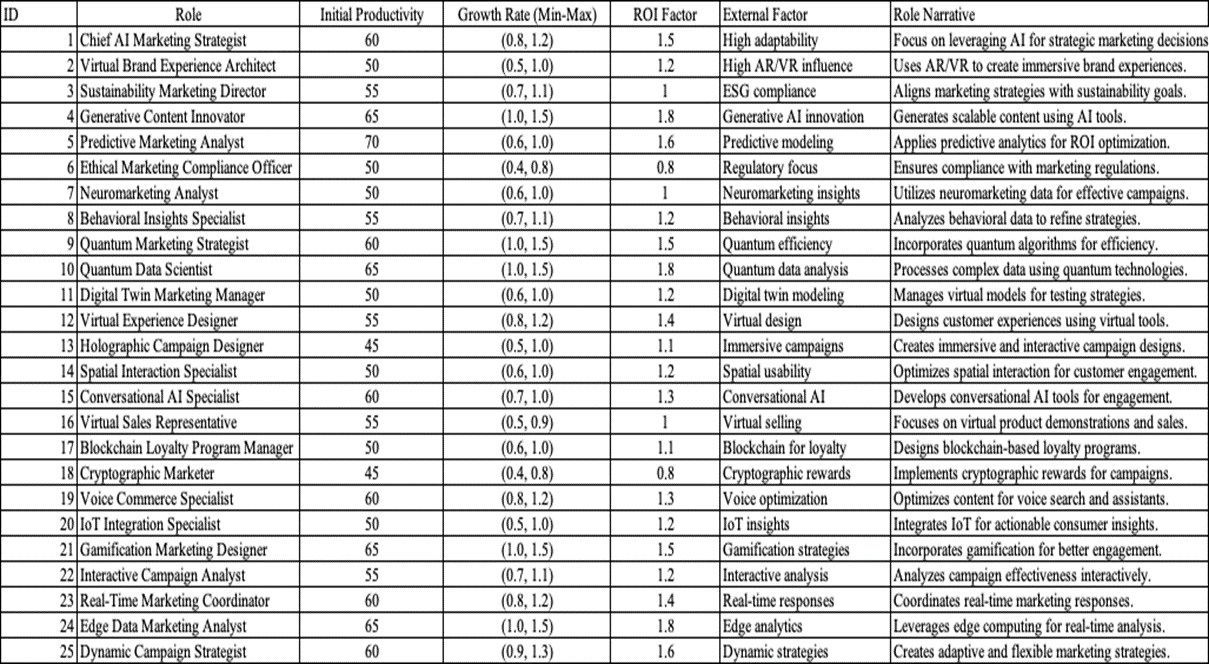
Note :Parameters represent structured simulation assumptions informed by capability logic rather than observed firm-level data
Step C: Agent Interaction
Agents operate within a simulated marketing ecosystem and adapt based on:
- External factors: technological diffusion rates, market volatility
- Internal factors: productivity growth, societal contribution accumulation
- Inter-role dependencies: collaboration effects and capability complementarities
Step D: Dynamic Evolution
Through iterative time steps (monthly cycles), agents evolve. Attribute updates allow nonlinear effects to emerge, including:
- Productivity acceleration
- ROI concentration among high-technology roles
- Shifts in societal impact weighting
- System-level adaptation patterns
3.5. Simulation Setup and Parameters
Time Horizon
The model simulates a five-year period (2025–2030) using monthly time steps (60 iterations).
Core Parameters
- Number of agents (roles): 25
- Societal impact weights:
- Environmental: 0.40
- Inclusivity: 0.30
- Transparency: 0.20
- Cultural: 0.10
Outputs
The model generates both aggregate and role-level outputs:
Aggregate Metrics
- Average productivity
- Total ROI contribution
- Total societal impact
Role-Specific Trends
- Productivity trajectories
- ROI accumulation patterns
- Societal contribution evolution
6. ABM Visualization and Analysis
Simulation Outputs are presented via
- Time-Series Line graphs for average productivity, ROI, and societal impact.
- Interactive visualizations illustrating agent interactions and clusteringGrid-based displays illustrating agent movements and clustering behaviors.
Framing of Simulation Outputs
The numerical outputs presented in this study (e.g., productivity percentages and ROI figures) are scenario-based simulation results derived from stylized parameter assumptions within the Agent-Based Model. They do not represent empirical forecasts or real-world financial predictions. Rather, they illustrate directional dynamics under specified assumptions regarding technology adoption rates, skill growth, and inter-role interactions. Absolute values should therefore be interpreted as exploratory modelling outputs, with relative trends and interaction effects being the primary analytical focus.
4. Result Interpretation
The results (Figures 3-6) provide insights into:
- Role prioritization based on productivity and societal impact.
- Long-term trends in marketing roles aligning with BRAVE technologies.
- Strategies for optimizing marketing teams in a dynamic technological landscape.
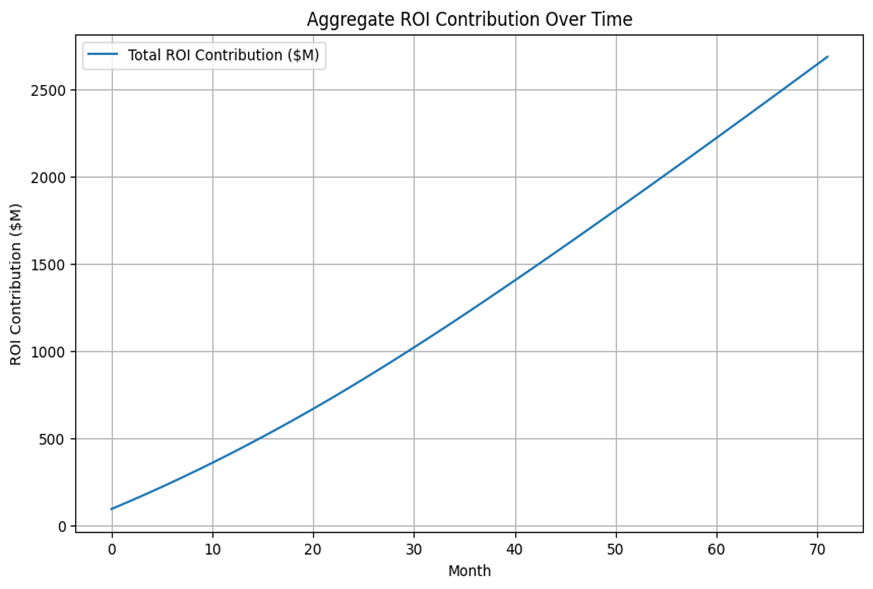
Figure 3: Aggregate ROI Contribution over time
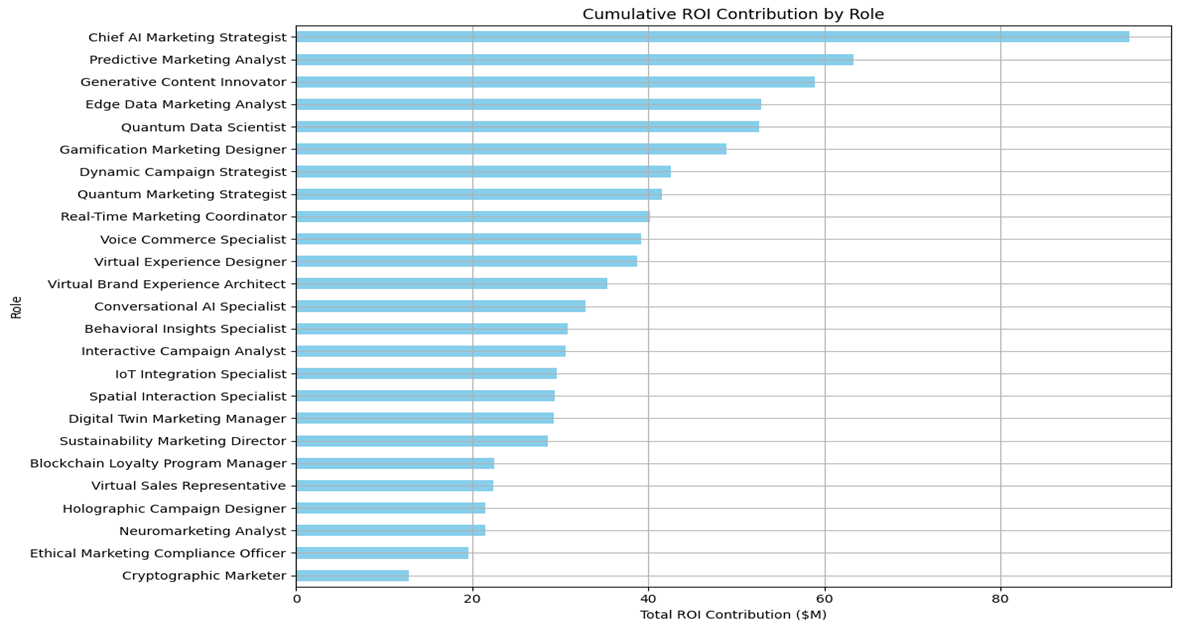
Figure 4: Cumulative ROI contribution by role over simulation period (2025-30)
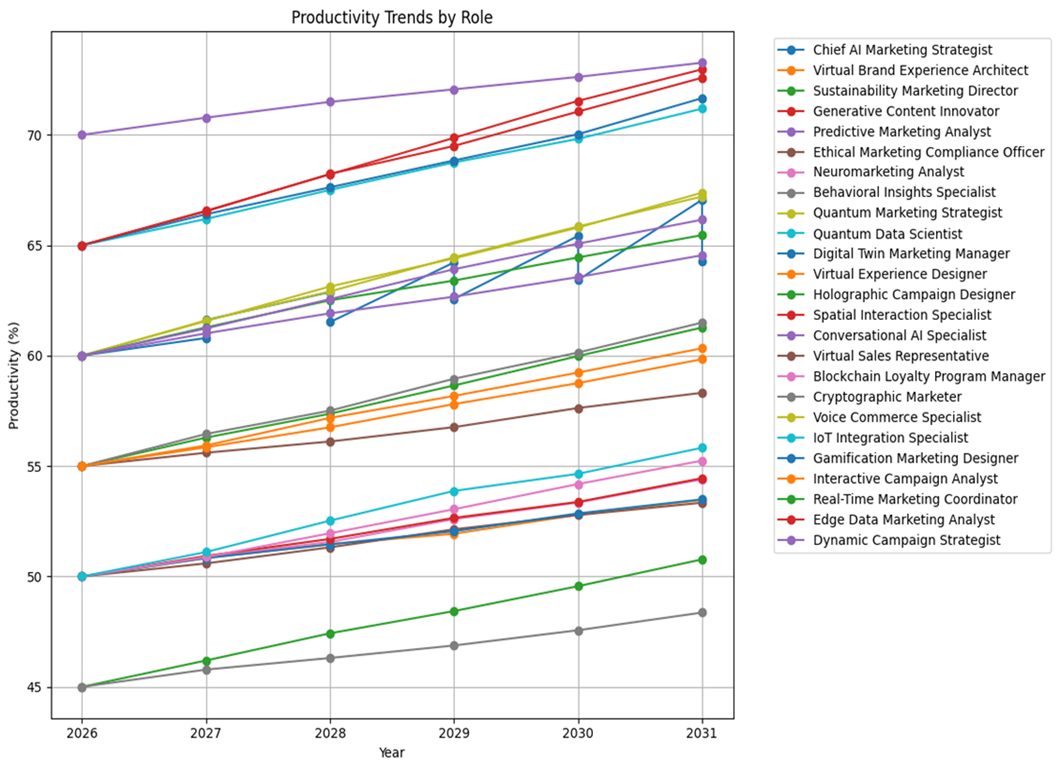
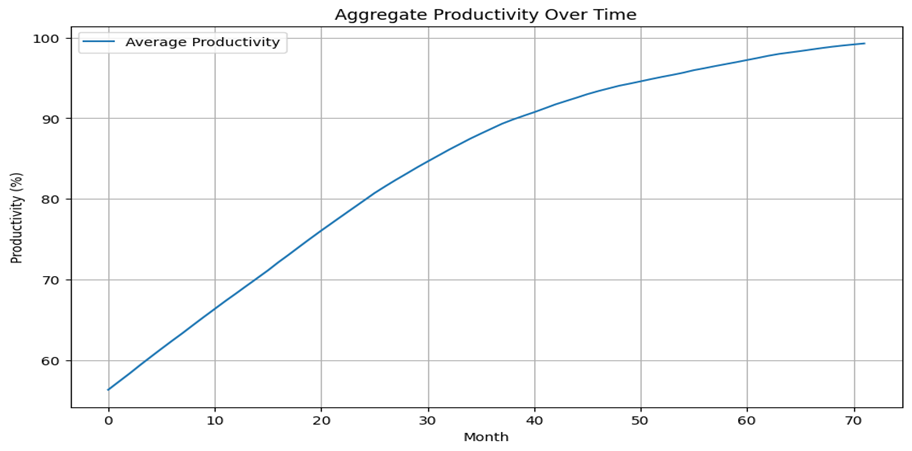
Figure 5: Aggregate Productivity Over Time
Figure 6: Productivity Trends by Role
4.1 Emerging BRAVE Technologies and Impact on the Future of Work in Marketing
BRAVE is reshaping how brands reach and engage consumers and the nature of work within the marketing profession through reshaping marketing skills, roles, and work structures towards a data-driven, personalized, and ethical future with marketers combining strategic thinking with technological proficiency. This evolution promises to make marketing more engaging, transparent, and aligned with consumer expectations while demanding an ethically conscious, technologically fluent, adaptable workforce. As we see with the marketing activities, marketers are transitioning from traditional roles to more tech-centric skills, combining data science, AI ethics, automation oversight, and generative content creation for virtual environments. New job roles accompany the technologies. Emerging roles include Metaverse Marketing Specialist, AI-Driven Insight Analyst, Blockchain Trust Manager, and Automation Strategist, each requiring a hybrid skillset blending traditional marketing with technological expertise. At the same time, the rise of digital tools and virtual environments supports remote work, with virtual collaboration and project management becoming key. This points to marketing teams increasingly operating as distributed networks connected through digital infrastructure.
As data and personalization become central to marketing, skills in ethics, privacy management, and consumer rights are essential. Therefore, marketing professionals expect to understand the ethical implications of data use and immersive experiences while staying updated on emerging tools and best practices. Furthermore, as we move toward 2030, marketing is undergoing a seismic shift, with BRAVE disrupting marketing career paths. Customers demand personalization, immersive experiences, and ethical practices. Companies embracing sustainability and leveraging AI will likely emerge as industry leaders.
4.2 A Marketing Structure for 2030
To integrate BRAVE technologies effectively, marketing organizations have potential to adopt a dual-layer structure comprising strategic leadership roles and functional innovators with each leadership team member helping drive a team of 5 or 6 specialists. Dependent on the size of the enterprise, the roles are full time equivalents (FTEs) or fractional for smaller organisations. Key marketing roles for 2030 in major enterprises, reflect trends of AI, personalization, sustainability, and immersive technologies (Table 4). The functional and leadership roles emerge from the underlying technology comprising the BRAVE taxonomy (Table 5).
The ABM (Agent-Based Model) simulates the transformation of marketing roles influenced by BRAVE (Blockchain, Robotics, AI, Virtual reality, and Environmental sustainability) technologies, assessing productivity, ROI impact, and role dynamics over 2025-2030 of 26 newly defined roles including six core leadership roles (Figure 4). The ABM reveals significant trends and insights driven by role-specific skill enhancements and BRAVE technology adoption. The productivity trends by role represent the evolution of each role effectiveness as a percentage in contributing to overall marketing efforts. These trends highlight:
Growth Over Time can vary between roles, reflecting differences in adaptability, technological reliance, and strategic importance.
- Average productivity increases from 56.35% in 2025 to 61.40% in 2030
- Productivity starts at a defined initial percentage (e.g., 50-70%) and grows due to role-specific skill enhancements, adaptive learning, and external factors.
Real-world factors of external market conditions, innovation adoption, and adaptive behaviors introduce variability. For example, the role of Chief AI Marketing Strategist might experience a rapid increase due to early AI adoption, while Holographic Campaign Designer shows slower initial growth but accelerate as AR/VR technologies mature. Roles requiring high innovation and adaptability, such as Generative Content Innovator or Quantum Data Scientist, might show steep productivity increases. Roles more operational or compliance-focused, Ethical Marketing Compliance Officer, exhibit steadier, less dramatic growth. By visualizing individual role trends, organizations identify high-performing roles that drive overall productivity gains. Conversely, roles with slower growth might need additional resources or strategic realignment.
4.2.1. Strategic Alignment
The productivity trends underscore roles crucial to the organization future marketing strategy. For instance, leadership roles of the Chief AI Marketing Strategist and Sustainability Marketing Director demonstrate consistent productivity growth, signalling alignment with the broader strategic focus on AI-driven insights and ESG (Environmental, Social, and Governance) priorities. Functional roles of the Blockchain Loyalty Program Manager and Holographic Campaign Designer also exhibit notable trends, reflecting an organizational commitment to leveraging cutting-edge technologies for consumer trust and engagement.
4.2.2. Investment Decisions
Analyzing productivity trends provides actionable data to guide resource allocation. Roles with high productivity growth of the Predictive Marketing Analyst and Generative Content Innovator, indicate a strong ROI for training, upskilling, and technological support. Roles with moderate growth but significant potential, the Digital Twin Marketing Manager, suggest a need for investment in infrastructure and tools to unlock their full productivity. Lower-performing roles of the Cryptographic Marketer may require targeted interventions, such as niche training or role realignment, to achieve better outcomes.
4.2.3. Role Maturity
The trends reveal how quickly roles adapt and become effective over time, a critical factor in marketing workforce planning. Rapid maturity in roles like the Quantum Marketing Strategist and Voice Commerce Specialist indicates a readiness for scaling and increased responsibilities. Gradual growth in roles such as the Virtual Sales Representative highlights an evolving nature, requiring sustained investment and support to fully realize potential. Roles with slower adaptation rates, like the Ethical Marketing Compliance Officer, reflect their dependency on external factors as regulatory changes or organizational culture, requiring a more strategic, long-term approach.
4.2.4. Implications for Organizational Strategy
The insights from productivity trends are pivotal for aligning marketing roles with the organization's future goals. By focusing on roles with the strongest alignment, optimizing investments, and nurturing maturity across functions, organizations can build a resilient, forward-looking marketing workforce ready to thrive in the evolving landscape of 2030.
4.2.5. Role-Specific Contributions
Figure 6 represents the cumulative ROI contributions over the 5-year simulation period, from 2025 to 2030. These values aggregate the financial impact of each role's productivity and ROI dynamics throughout the simulation timeframe. Under the model parameter assumptions, total simulated ROI contribution increases from $94.00M in 2025 to $220.70M in 2030, illustrating how compounded role productivity dynamics may scale financial impact within the stylized ecosystem. The contribution highlights the value of early investment in BRAVE technologies. The findings underscore the transformative potential of BRAVE technologies in reshaping marketing roles and strategies.
- Synergies: Collaborative interactions between leadership and functional roles maximize the impact of emerging technologies.
- Early Adoption: Investing in advanced technologies like blockchain and AR/VR provides a competitive edge.
- Continuous Learning: Upskilling remains essential for workforce adaptability, ensuring organizations can keep pace with innovation.
These insights provide a roadmap for organizations to align marketing strategies with technological advancements and societal expectations, fostering resilience and innovation. This reporting demonstrates the utility of ABM in modelling the future of marketing workforces. By simulating role dynamics, productivity trends, and technology adoption, the model offers actionable insights for organizations to thrive in a rapidly evolving landscape. The findings emphasize the importance of integrating BRAVE technologies and investing in skill development to achieve sustainable growth.
4.3. How BRAVE Technologies Transform Marketing Workforces
- Skill Enhancement
- AI-related skills see the fastest growth, reflecting a pervasive role in analytics, personalization, and campaign optimization.
- Blockchain skills show moderate growth, driven by increasing adoption for transparency in digital marketing.
- Robotics skills grew steadily, influenced by the automation of repetitive marketing tasks.
- Vital infrastructure skills rose due to the growing need for immersive technologies like AR/VR in consumer engagement.
- Environmental skills highlight the rising importance of sustainability in marketing strategies.
- Workforce Adaptability
- Cross-training synergies: AI significantly boosted growth in related skills, such as robotics and infrastructure management.
- Learning curve variation: Roles like data scientists exhibited faster adaptability compared to traditional marketers.
- Resistance to obsolescence: Diverse skill sets reduced the risk of roles being rendered obsolete by automation.
- Future Implications for Workforce Development
- Training Programs: Targeted skill development in AI, robotics, and blockchain is critical for workforce competitiveness.
- Ethical Considerations: Training in the responsible use of AI and environmental technologies must be prioritized to align marketing practices with societal values.
- Role Evolution: Marketing roles will increasingly integrate technical expertise, requiring a blend of creativity, analytical thinking, and technological proficiency.
4.4. Applications of ABM Insights for Marketing Workforce Development
- Targeted Training Investments
- Data-driven insights from the ABM identify skills with the highest growth potential, helping organizations prioritize training resources effectively. For example, accelerating AI training can have downstream effects on enhancing related skills like robotics and analytics.
- Scenario Planning
- Simulated scenarios allow marketing organizations to prepare for various futures, such as rapid adoption of environmental technologies or shifts toward decentralized marketing teams.
- These insights help organizations remain agile and future ready.
- Customized Workforce Strategies
- Workforce strategies can be tailored to individual roles based on their adaptability to BRAVE technologies, ensuring inclusive growth.
- Roles like CRM managers can benefit from additional training in vital infrastructure, while content creators focus on leveraging AI for personalization.
The integration of BRAVE technologies is transforming the marketing profession, reshaping skill requirements, and redefining the future of work in the sector. By combining insights from authoritative sources, ABM and quantitative data, this research provides a comprehensive framework for understanding and addressing these changes. The findings emphasize the importance of targeted workforce development, ethical application of emerging technologies, and adaptive strategies to ensure the marketing sector remains innovative, sustainable, and future-ready. Further, this approach not only offers actionable insights for workforce training but also establishes a replicable methodology for exploring the intersection of emerging technologies and the future of work across other sectors.
This approach satisfies data-driven and technology-enabled strategies for a transformative future by combining empirical insights with advanced modelling techniques. Here is how each aspect contributes to meeting these goals:
1. Data-Driven Insights
- Informed by Authoritative Sources: The BRAVE framework is built on data gathered from reputable sources like Gartner, McKinsey, IEEE Spectrum, and the World Economic Forum. These insights help identify which emerging technologies are most relevant for the marketing sector and the future of work.
- Empirical Simulation with ABM: By running an ABM, this approach captures skill growth, role adaptability, and interactions between agents and BRAVE technologies. This simulated data allows marketers to visualize how skills may evolve in response to technology, providing a realistic foundation for strategic planning.
- Quantifiable Skill Growth Metrics: The model outputs skill growth over time, highlighting which skills (AI, blockchain, robotics, etc.) are likely to see the most improvement and need further development. This data-driven insight is valuable for designing targeted training programs.
2. Technology-Enabled Strategies
- ABM serves as a technology-enabled method to simulate and predict future scenarios. This model allows stakeholders to test different workforce development strategies and training investments, showing how they impact skill adaptability and preparedness for emerging technology adoption.
- Automation and Cross-Technology synergies ensure the simulation includes learning rates and synergies (like AI enhancing robotics skills), enabling marketers to see the compounded effect of skills working together. This informs strategic decisions about workforce structure and areas where technological cross-training is beneficial.
- Scenario Analysis for Future-Readiness simulates various scenarios (e.g., rapid AI adoption vs. steady growth in environmental skills), this approach enables organizations to explore possible futures, preparing them to act quickly and make informed decisions in a rapidly evolving tech landscape.
3. Transformation Focused Outcomes
- Proactive Skill Development leverage the insights generated from the ABM guiding organizations to prioritize resources for skills likely to be in high demand, positioning the workforce for future competitiveness and resilience.
- Ethical and Sustainable Framework building on environmental technology and ethical implications aligns with the industry 5.0 values of human-centric, sustainable innovation. This framework sets a foundation for a responsible and transformative marketing profession.
- Tailored Workforce Strategies support customized development plans, informed by ABM data, help organizations address individual role needs, promoting inclusive growth across diverse marketing roles and fostering a future-ready workforce.
4.5. Implications for Marketing - Strategic Perspective of Interdisciplinary & Regulatory
For marketing, the integration of emerging technologies with societal priorities presents both opportunities and challenges. The critical implication requires organizations and stakeholders to align marketing strategies with broader societal goals. The rise of BRAVE necessitates a shift in how organizations balance innovation with societal impact. To achieve meaningful outcomes, businesses must bridge the gap between technological capabilities and the needs of the communities they serve. This requires a focus on ethical innovation, ensuring marketing practices foster trust, inclusivity, and sustainability. By strategically integrating these elements, organizations can position themselves as leaders in addressing global challenges while achieving business growth. This complex interplay of technology and society calls for interdisciplinary collaboration. Marketing professionals must work closely with experts in sociology, environmental science, and behavioral psychology to create strategies capable of resonating with diverse audiences. These partnerships uncover deeper insights into consumer behavior, enable the design of campaigns that align with cultural norms, and address pressing issues such as climate change and social equity. The blending of these disciplines fosters a holistic approach to marketing both innovative and impactful at micro, mesa and macro levels (Clayton, 2025).
As marketing becomes increasingly data-driven, navigating the complexities of consumer privacy and data protection is critical. Differing legal frameworks across regions, General Data Protection Regulation (GDPR) in Europe or California Consumer Privacy Act (CCPA) in California, pose significant challenges for global organizations. Harmonizing marketing practices with these regulations requires proactive engagement with policymakers and investment in privacy-preserving technologies e.g., homomorphic encryption (Apple Machine Learning Research, 2024) and blockchain. Achieving global regulatory alignment not only mitigates compliance risks but also builds consumer trust in an era of heightened privacy concerns.
5. Conclusion
This study contributes theoretically, methodologically, and substantively to marketing scholarship. Theoretically, it extends taxonomy development methodology into the domain of marketing role design by constructing the BRAVE framework through a structured, transparent process. Methodologically, we integrate taxonomy construction with agent-based modelling (ABM), demonstrating how structured foresight is operationalizable into scenario-based organizational simulations. Substantively, the method provides a structured mechanism for organizations to translate technology foresight into workforce architecture and strategic capability design. The hypothetical case study (Box 1 “A Comprehensive Approach to Transitioning to BRAVE Marketing”) serves as an instantiation of the framework. The case operationalizes the full pipeline developed in this study: (1) identifying BRAVE technologies, (2) translating them into capability domains, (3) mapping capabilities into emergent marketing roles, and (4) simulating their interaction through ABM to explore performance trajectories across ROI, productivity, and societal impact metrics. In doing so, the case demonstrates how ABM simulations can be used not as predictive tools, but as structured scenario-testing mechanisms for organizational design under technological uncertainty.
The integration of BRAVE technologies into marketing fosters a transition from transaction-centric models toward ecosystems grounded in inclusivity, transparency, and trust. This shift reflects a broader movement consistent with Industry 5.0 principles, emphasizing ethical, human-centric, and sustainable innovation.
Blockchain technologies enable decentralized models of finance and exchange (e.g., DeFi; Schär, 2021), reducing intermediary dependence while enhancing supply chain transparency and empowering smaller market actors. Robotics and automation restructure operational efficiency, shifting labor composition toward knowledge-intensive, adaptive roles. AI and machine learning hyper-personalize engagement and enable predictive capability, transforming one-size-fits-all markets into dynamic, micro-segmented ecosystems. Vital infrastructure technologies (IoT, 5G, edge computing, quantum networks) facilitate real-time data exchange and system responsiveness. Environmental technologies embed regenerative logic into economic activity through circular systems, carbon accounting, and renewable integration.
Transparency becomes structurally embedded and not just asserted through communications. Blockchain-based ledgers allow verification of sourcing and carbon claims. AI-driven reporting systems generate real-time operational disclosures. IoT-enabled infrastructures provide lifecycle visibility. Environmental platforms enable measurable sustainability performance. In this reconfigured system, trust emerges from verifiability, not branding rhetoric. Consumer trust is strengthened not merely through personalization but through ethical architecture. Decentralized data control enhances consumer agency. Regulated AI systems increase algorithmic transparency. Sustainability commitments become quantifiable rather than symbolic. These developments redefine marketing’s institutional role from persuasion to stewardship.
The boxed case study illustrates a small, strategically designed BRAVE marketing team aligning with enabling technologies generating high ROI and productivity while simultaneously improving societal metrics such as environmental impact and transparency scores. The simulation demonstrates organizational performance is not solely a function of headcount but of capability configuration and interaction effects across roles. In this sense, ABM becomes a tool for exploring alternative organizational equilibria under technological disruption.
By 2030, marketing leadership titles will likely evolve beyond the traditional Chief Marketing Officer toward roles that explicitly incorporate intelligence systems, ethics governance, sustainability stewardship, and infrastructure orchestration. The “BRAVE Marketer” represents not a job title but a capability archetype integrating technological fluency with societal accountability.
Ultimately, this study underscores that the future of marketing is not determined by technology adoption alone but by structured integration of technology into role architecture, governance systems, and strategic simulation. The BRAVE framework, combining with agent-based scenario modelling, provides organizations with a replicable pathway for navigating uncertainty while aligning economic performance with societal impact.
To demonstrate the applied implications of the BRAVE taxonomy and ABM outputs, we present the following illustrative scenario.
Box 1. Illustrative Scenario –Transitioning to BRAVE Marketing (Derived from ABM Scenario Modelling)
The implementation of marketing activities using the BRAVE taxonomy creates measurable improvements in trust, engagement, and sustainability. By integrating emerging technologies and continuously monitoring outcomes, organizations can transition into a transparent, consumer-centric, and environmentally sustainable marketing future. This hypothetical study exemplifies how strategic adoption of emerging technologies aligns with business goals while addressing societal and environmental imperatives. In a bid to adapt to evolving consumer desire for brands to adopt sustainable practices and achieve more utilising AI, a global retail brand undertakes a strategic shift to implement BRAVE driven marketing practices.
Steps in BRAVE Transition
- Blockchain for Transparency - Loyalty programs are restructured using blockchain technology, enabling customers to access transparent and tamper-proof records of rewards and ad deliveries.
- AI for Personalization - Artificial intelligence automates the generation of personalized offers, increasing relevance and customer satisfaction.
- AR/VR for Immersive Experiences - Augmented and virtual reality technologies create virtual try-on options for products, fostering an interactive and engaging shopping experience.
- Robotics for Efficiency - Robots are deployed in retail outlets to provide 24/7 customer service, ensuring uninterrupted support and convenience.
- Environmental Technologies for Sustainability- Campaign emissions are monitored and offset using renewable energy solutions and carbon accounting tools.
Outcomes Achieved from Adoption of BRAVE technologies
- 40% increase in Consumer Trust, driven by blockchain-enabled transparency and AI-driven personalized experiences.
- 50% Engagement boost due to immersive AR/VR storytelling and predictive analytics for targeted recommendations.
- 30% Carbon Footprint reduction achieved through energy-efficient marketing platforms and environmentally conscious practices.
Quantifying Impact
Baseline Metrics (hypothetical):
- 60% Trust measured via surveys and Net Promoter Scores.
- 40% Engagement based on click-through rates and time spent.
- 100 tons Carbon Footprint calculated using lifecycle assessment tools.
Post-Transition Metrics:
- Trust - Increases to 84% (+40%).
- Engagement - Rises to 60% (+50%).
- Carbon Footprint - Drops to 70 tons (-30%).
Statistical validation techniques, paired t-tests or ANOVA, confirm the significance of improvements across all metrics.
Attribution of Outcomes
- Trust Gains attributable to Blockchain & AI enhancing transparency & relevance, directly impact consumer trust.
- Engagement Boosts built on Immersive AR/VR campaigns & predictive analytics to foster deeper consumer engagement.
- Carbon Reduction emerges from Energy-efficient technologies and carbon-neutral platforms drive measurable environmental benefits.
Using Agent-Based Models for Simulation when real-world data is incomplete, Agent-Based Models (ABMs) simulate consumer interactions with BRAVE technologies: Agents represent customers and consumer behaviors.
- Behavior Rules incorporate trust increases via blockchain or improved engagement through AR/VR.
- Simulations predict outcomes based on hypothetical scenarios to validate findings.
- Sustained Monitoring for Long-Term Impact
To ensure consistent improvements: Conduct regular trust surveys/Track engagement metrics using analytics tools. /Annual carbon footprint audits.
References
- Apple Machine Learning Research. (2024, October 24). Homomorphic encryption. Apple. https://machinelearning.apple.com/research/homomorphic-encryption
- Bharati, R. (2023). Building next-generation marketing teams: Navigating the role of AI and emerging digital skills. EIPRM Journal, 5(2), 1–7. https://doi.org/10.56614/eiprmj.v5i2y16.320
- Clayton, E. (2025, March 25). The three dimensions of modern marketing: Macro, meso, and micro marketers. LinkedIn. https://www.linkedin.com/in/emmaclayton
- Faiza, A., Bukhsh, A., Govers, R., Bemthuis, R., & Iacob, M.-E. (2024). Exploring the integration of agent-based modelling, process mining, and business process management through a text analytics–based literature review. In The Oxford handbook of process management. https://doi.org/10.1093/oxfordhb/9780197668122.013.20
- Mandel, I., Balsim, I., Grier, J., & Mastrianni, T. (2013). Agent-based models in marketing: Statistical and self-organizing aspects. Model Assisted Statistics and Applications, 8(1), 69–82. https://doi.org/10.3233/MAS-2012-0238
- Eh, I., Štorga, M., & Dela, G. (2022). Agent-based modelling: Parallel and distributed simulation of product development team. Tehnički vjesnik – Technical Gazette, 29(4). https://doi.org/10.17559/tv-20200922160617
- McAlister, L., Germann, F. A., Chisam, N., Hayes, P., Lynch, A., & Stewart, B. (2022). A taxonomy of marketing organizations. Journal of the Academy of Marketing Science, 51(3), 1–19. https://doi.org/10.1007/s11747-022-00911-5
- McClaren, N., & Shaw, R. (2003). Marketing position taxonomies: An empirical analysis. [Conference or journal title missing], 1854–1860.
- Nickerson, R. C., Varshney, U., & Muntermann, J. (2013). A method for taxonomy development and its application in information systems. European Journal of Information Systems, 22(3), 245–259. https://doi.org/10.1057/ejis.2012.26
- Mwilu, O. S., Prat, N., & Comyn-Wattiau, I. (2015). Taxonomy development for complex emerging technologies: The case of business intelligence and analytics on the cloud. In Proceedings of the Pacific Asia Conference on Information Systems (PACIS). https://hal.science/hal-01636577v1/document
- Crowder, R., Hughes, H., Sim, Y. W., & Robinson, M. A. (2009). An agent-based approach to modelling design teams. [Conference proceedings], 91–102.
- Schär, F. (2021). Decentralized finance: On blockchain- and smart contract-based financial markets. Federal Reserve Bank of St. Louis Review, 103(2), 153–174. https://doi.org/10.20955/r.103.153-74
- Surowiecki, J. (2004). The wisdom of crowds. Doubleday.
- Koed Madsen, T., & Ohrt Rosenbaum, G. (2018). The roles of INVs and their agents in the organization of marketing tasks. In Advances in international marketing (pp. 79–97). https://doi.org/10.1007/978-3-319-61385-7_4
- Tetlock, P. E., & Gardner, D. (2015). Superforecasting: The art and science of prediction. Crown.
- Rand, W. (2024). Agent-based modelling in marketing. In The Oxford handbook of marketing. https://doi.org/10.1093/oxfordhb/9780197668122.013.8
Appendix A
Emerging Technologies by Authoritative Source (2024)
| Gartner Hype Cycle | MIT Tech Review | IEEESpectrum |
| AI-Augmented Software Engineering | AI for Everything | Wi-Fi 7 for stable, multi-link connectivity |
| AI Supercomputing | Super-Efficient Solar Cells | HVDC networks in Europe |
| Generative AI | Apple Vision Pro | Content credentials for combating deepfakes |
| WebAssembly | Weight-Loss Drugs | Algorithmic video surveillance |
| Autonomous Agents | Enhanced Geothermal Systems | NASA’s Artemis II lunar mission |
| Digital Twin of a Customer | Chiplets | Homomorphic encryption chips for data security |
| Homomorphic Encryption | The First Gene-Editing Treatment | Carbon-sequestering kelp farms |
| Artificial General Intelligence | Exascale Computers | Intel’s next-gen chip technology |
| Cybersecurity Mesh Architecture | Heat Pumps | Blue PHOLED displays |
| Humanoid Working Robots | Twitter Alternatives | Synchron brain-implant technology |
| Large Action Models | CB Insights | ARK Invest |
| World Economic Forum | GPU | Technological Convergence[2] |
| AI for scientific discovery | Multimodal AI | Artificial Intelligence |
| Privacy-enhancing technologies | Synthetic data | Bitcoin Allocation |
| Reconfigurable intelligent surfaces | No code software | Bitcoin In 2023 |
| High altitude platform stations | Quantum computing commercialization | Smart Contracts |
| Integrated sensing and communication | Cyber chaos drives security consolidation | Digital Consumers |
| Immersive technology for the built world | AI & security | Digital Wallets |
| Elastocalorics | Bank AI FOMO | Precision Therapies |
| Carbon-capturing microbes | Blockchain finserv | Multiomic Tools & Technology |
| Alternative livestock feeds | Extreme weather insurtech | Electric Vehicles |
| Genomics for transplants | AI drug race | Robotics |
| McKinsey Report | Digital therapeutics | Robotaxis |
| Generative AI | Brain | Autonomous Logistics |
| Applied AI | AI sales agents | Reusable Rockets |
| Industrializing Machine Learning (MLOps) | AI loss prevention | 3D Printing |
| Immersive Reality Technologies (AR/VR) | AI gaming | |
| Quantum Technologies | Humanoid robots | |
| Cloud and Edge Computing | ||
| Next-generation Software Development | ||
| Future of Space Technologies | ||
| Electrification and Renewables |
Appendix B
Conceptual Design of the Agent-Based Model (ABM)
C.1 Purpose and Scope
This agent-based model (ABM) simulates the evolution of productivity and return-on-investment (ROI) contributions of 26 distinct marketing roles over the period 2025–2030. The objective is not to generate financial forecasts, but to examine the structural dynamics through which emerging, technology-enabled marketing roles may influence aggregate organizational capability and financial performance under defined assumptions. The model conceptualizes each marketing role as an autonomous agent with productivity evolving over time and contribution to financial output in a non-linear manner. Aggregate organizational outcomes emerge from the combined behavior of these individual agents.
C.2 Conceptual Structure
Agents
Each agent represents a distinct marketing role (e.g., AI-driven strategist, immersive brand architect, neuromarketing specialist). Agents are characterized by five parameters:
- Baseline productivity – Initial effectiveness level at model start (2025).
- Growth range – Annual stochastic productivity increment reflecting learning, technological leverage, and skill maturation.
- Baseline ROI contribution – Initial financial contribution attributed to the role.
- ROI sensitivity factor – The strength of the relationship between productivity and financial output.
- External variability factor – A stochastic modifier representing environmental volatility (e.g., market uncertainty, regulatory change, organizational constraints).
Agents evolve independently across discrete time steps (six periods corresponding to 2025–2030).
C.3 Dynamic Assumptions
The model is governed by four core assumptions:
(1) Stochastic Productivity Growth
Productivity increases annually within a predefined range. Growth is probabilistic rather than deterministic, reflecting uncertainty in adoption, AI augmentation, skill acquisition, and organizational learning processes.
(2) Non-Linear ROI Response
ROI contribution is modelled as a non-linear function of productivity. This reflects compounding mechanisms commonly observed in digital and AI-enabled environments, including automation scale effects, data network externalities, and platform leverage. Consequently, marginal improvements in productivity generate disproportionately larger financial effects over time.
(3) Environmental Volatility
Each agent is subject to a bounded stochastic modifier to represent macro-level uncertainty. This ensures that trajectories reflect real-world variability rather than smooth exponential growth.
(4) Productivity Ceiling
Productivity is capped at an upper bound (100%) to prevent unrealistic compounding and to reflect structural limits in organizational performance.
C.4 Model Outputs
The ABM produces three levels of output for analytical interpretation.
(1) Average Workforce Productivity
This metric represents the mean productivity across all agents at each time step. It serves as an indicator of aggregate organizational capability development.
Interpretation:
- An upward slope reflects collective capability maturation.
- A plateau indicates saturation or diminishing marginal gains.
- Steeper gradients imply rapid technological or strategic leverage.
This metric reflects capability evolution rather than financial performance.
(2) Total ROI Contribution
This metric aggregates the financial output of all agents per period. Given the non-linear ROI function, the trajectory may exhibit acceleration over time.
Interpretation:
- Convex (accelerating) growth suggests compounding strategic advantage.
- Linear growth indicates stable scaling.
- Flattening curves imply under-leveraged capabilities.
The shape of the curve is analytically more important than absolute magnitude.
(3) Role-Level Productivity Trajectories
Individual agent trajectories reveal heterogeneity across roles.
Interpretation:
- High initial productivity with low growth suggests mature roles.
- Lower initial productivity with steep growth suggests emergent or disruptive roles.
- Divergence between trajectories indicates strategic differentiation potential.
This level of analysis enables examination of whether specialist or innovation-oriented roles generate disproportionate long-term contribution relative to foundational roles.
C.5 Analytical Interpretation
The model enables structured exploration of four strategic questions:
- Which roles generate disproportionate long-term ROI growth?
- Do emerging roles overtake established roles over time?
- Does aggregate organizational capability scale meaningfully?
- Does financial impact compound as productivity matures?
Importantly, the model is illustrative rather than predictive. It is designed to simulate relative structural dynamics under controlled assumptions, not to forecast empirical financial outcomes.
C.6 Methodological Justification
Agent-based modelling is appropriate in this context for three reasons:
- Heterogeneity – Marketing roles differ in growth potential and financial leverage.
- Non-linearity – Financial returns may scale disproportionately relative to productivity improvements.
- Emergence – Macro-level outcomes (total ROI) emerge from micro-level behavioral rules.
The ABM thus functions as a structured scenario exploration tool for examining workforce evolution in AI-augmented marketing environments.
Appendix C
Model Implementation Notes and Computational Specification
D.1 Overview
This appendix documents the computational structure of the agent-based model (ABM) described conceptually in Appendix C. The purpose of this section is to provide implementation transparency and enable reproducibility without duplicating the conceptual rationale.
The model is implemented in Python using the Mesa agent-based modeling framework. The code operationalizes the productivity growth and ROI dynamics through explicit update rules and structured data collection.
D.2 Agent Update Equations
At each discrete time step , each marketing role agent updates its productivity and ROI contribution according to the following rules:
Productivity Update
Where:
- = productivity of role at time
- = stochastic growth draw within role-specific range
- = bounded external variability factor
- 100 = upper productivity ceiling
This rule ensures bounded, stochastic, and heterogeneous productivity growth across roles.
ROI Update
Where:
- = financial contribution at time
- = non-linearity exponent (compounding effect)
- = role-specific ROI sensitivity factor
- = scaling constant
The exponent introduces convexity, reflecting digital scaling and AI-driven leverage effects.
D.3 Role Parameterization
Each of the 25 roles is initialized using a structured parameter schema:
| Parameter | Description |
|---|---|
| productivity | Baseline capability level (0–100) |
| growth_rate | Annual productivity growth interval |
| roi_contribution | Initial financial contribution |
| roi_factor | Sensitivity multiplier linking productivity to ROI |
Roles differ in both baseline capability and growth potential, enabling heterogeneity within the simulation.
D.4 Simulation Process
The simulation proceeds as follows:
- Initialize agents with role-specific parameters.
- Randomize agent activation order per time step.
- Apply productivity update rule.
- Apply ROI update rule.
- Collect model-level and agent-level metrics.
- Repeat for six time steps (2025–2030).
Random activation prevents deterministic ordering effects and supports emergent behavior.
D.5 Data Collection Structure
The model collects two levels of metrics:
Model-Level Metrics
- Average productivity across agents
- Total ROI contribution across agents
Agent-Level Metrics
- Role identifier
- ROI contribution (and optionally productivity)
The resulting dataset is structured as a time-indexed panel allowing:
- Cross-sectional role comparison
- Longitudinal growth analysis
- Aggregate capability tracking
D.6 Computational Transparency
The full reference implementation is written in Python (Mesa framework) and includes:
- Agent class definition
- Model orchestration structure
- Data collection module
- Visualization routine
The implementation is modular, allowing:
- Adjustment of growth ranges
- Modification of non-linearity exponent
- Scenario testing under alternative volatility bounds
- Expansion to additional roles
Only partial role configuration is shown in the excerpt for brevity; the complete model instantiates all 25 roles under identical structural rules.
D.7 Implementation Scope and Limitations
The model:
- Does not simulate direct inter-agent interaction
- Assumes independent growth processes
- Uses bounded stochastic volatility rather than empirical macro data
- Is illustrative rather than predictive
The computational design prioritizes clarity, transparency, and scenario exploration over empirical calibration.
D.8 Reproducibility Statement
The model is implemented using Python (3.x) and the Mesa ABM framework. Dependencies include NumPy, Pandas, and Matplotlib. The code can be executed using standard Python environments and modified to test alternative parameterizations or extended time horizons.
D.9 Model Validation and Robustness Checks
To ensure structural integrity and analytical reliability, several validation and robustness procedures were implemented.
Structural Validation
The model was validated at three levels:
- Logical consistency checks
- Productivity is bounded within .
- ROI growth remains monotonic under positive productivity conditions.
- No negative financial contributions occur under baseline parameterization.
- Boundary testing
- Extreme growth-rate inputs (near zero or high upper bounds) were tested to confirm stability.
- Volatility bounds were expanded to assess convergence behavior.
- Internal coherence
- When the non-linearity exponent is set to 1.0, ROI growth becomes linear, confirming that convex growth patterns arise solely from the exponent parameter.
These checks confirm the emergent patterns are driven by model structure rather than computational artefacts.
D.10 Monte Carlo Sensitivity Extension
Because productivity growth and volatility are stochastic, outcomes vary across runs. To assess stability, a Monte Carlo simulation framework can be applied.
Procedure
- Run the model times (e.g., or ).
- Record final-period (2030) outcomes:
- Average productivity
- Total ROI
- Top-performing roles
- Compute:
- Mean outcome
- Standard deviation
- Confidence intervals
Analytical Interpretation
Monte Carlo analysis allows assessment of:
- Stability of aggregate ROI trajectories
- Variability in role dominance
- Sensitivity to volatility bounds
- Sensitivity to exponent
If aggregate ROI curves remain convex across runs, compounding behavior is structurally robust rather than path-dependent.
This extension transforms the model from a single scenario illustration into a probabilistic scenario envelope.
D.11 Theoretical Anchoring: Dynamic Capabilities Perspective
The model aligns with the dynamic capabilities framework (Teece, Pisano, & Shuen, 1997; Teece, 2007), which conceptualizes competitive advantage as the firm's ability to:
- Sense opportunities
- Seize opportunities
- Reconfigure resources
Within this ABM:
- Productivity growth operationalizes capability development (learning and reconfiguration).
- Non-linear ROI scaling reflects value capture through orchestration and deployment.
- Role heterogeneity mirrors differentiated microfoundations of capability.
- Emergent aggregate ROI reflects macro-level competitive advantage arising from micro-level capability investments.
The exponent captures compounding value creation consistent with digital platform economics and AI leverage, where marginal improvements yield disproportionate returns.
Thus, the ABM operationalizes dynamic capabilities as a computational experiment in capability evolution.
D.12 Positioning Within Strategic Theory
Beyond dynamic capabilities, the model also relates to:
- Resource-Based View (RBV) — heterogeneity in role configurations represents differentiated resources.
- Service-Dominant Logic (SDL) — roles act as operant resources generating value through capability application.
- Complex Adaptive Systems theory — aggregate financial performance emerges from decentralized agent behavior.
The ABM therefore serves as a structured microfoundational simulation of strategic capability accumulation under technological transformation.
Appendix D
Emerging Technologies by Category
1. AI & Machine Learning (20 technologies)
Artificial Intelligence
AI-Augmented Software Engineering
AI Supercomputing
Generative AI
Artificial General Intelligence
Applied AI
Large Language Models
AI for scientific discovery
AI weather prediction
AI agent marketplaces
Industrializing ML (MLOps)
Multimodal AI
Synthetic data
No code software
Bank AI FOMO
AI drug discovery
Digital therapeutics
AI sales agents
AI loss prevention
AI gaming
2. Digital Infrastructure & Computing (11 technologies)
Digital Infrastructure
Next-generation Software Development
Cloud and Edge Computing
Immersive Reality Technologies (AR/VR)
Reconfigurable intelligent surfaces
Integrated sensing and communication
High altitude platform stations
Immersive technology for the built world
Wi-Fi 7 for stable, multi-link connectivity
HVDC networks in Europe
Quantum computing commercialization
3. Healthcare and Biotechnology (11 technologies)
Genomics for transplants
Precision Therapies
Multiomic Tools & Technology
The First Gene-Editing Treatment
Cellular & epigenetic reprogramming
Biocomputing
Brain manipulation technology
Synchron’s brain-implant technology
Extreme weather insurtech
Weight-Loss Drugs
Brain tech
4. Sustainable Energy Solutions (10 technologies)
Sustainable Energy
Electrification and Renewables
Climate Technologies
Enhanced Geothermal Systems
Super-Efficient Solar Cells
Heat Pumps
Carbon-sequestering kelp farms
Carbon-capturing microbes
Alternative livestock feeds
Ultra-deep drilling
5. Blockchain and Cryptocurrency (5 technologies)
Bitcoin Allocation
Bitcoin in 2023
Smart Contracts
Digital Wallets
Technological Convergence (Artificial Intelligence, Public Blockchains, Multiomic Sequencing, Energy Storage, and Robotics)
6. Advanced Computing and Semiconductors (5 technologies)
Quantum Technologies
Quantum-optimized portfolios
Exascale Computers
Chiplets
Intel’s next-gen chip technology
7. Robotics and Automation (8 technologies)
Robotics
Humanoid Working Robots
Robotaxis
Autonomous Logistics
Reusable Rockets
3D Printing
Electric Vehicles
Humanoid robots
8. Immersive and Sensing Technologies (7 technologies)
Immersive Reality Technologies (AR/VR)
Reconfigurable intelligent surfaces
Integrated sensing and communication
High altitude platform stations
Immersive technology for the built world
Apple Vision Pro
Blue PHOLED displays
9. Security and Privacy Technologies (6 technologies)
Homomorphic Encryption
Homomorphic encryption chips for data security
Privacy-enhancing technologies
Content credentials for combating deepfakes
Algorithmic video surveillance
Cybersecurity Mesh Architecture
10. Space Exploration and Advanced Propulsion (3 technologies)
Future of Space Technologies
NASA’s Artemis II lunar mission
Advanced nuclear propulsion
11. Neurotechnology and Brain-Computer Interfaces (3 technologies)
Brain manipulation technology
Synchron brain-implant technology
Brain-Computer Interfaces
12. Advanced Navigation and Positioning Systems (1 technology)
GPS-less navigation systems
13. Advanced Display Technologies (1 technology)
Blue PHOLED displays
14. Digital Communication Platforms (1 technology)
Twitter Alternatives
15. Sustainable Agriculture and Food Technologies (1 technology)
Alternative livestock feeds
16. Sustainable Transportation (1 technology)
Electric vehicles
- In this study, “agents” refer to role-representing entities within an Agent-Based Model (ABM) used for simulation purposes. These should not be confused with “agentic AI workflows” in large language model (LLM) systems representing autonomous software pipelines capable of executing tasks. ABM agents model marketing role-level attributes and interactions in a stylized ecosystem, whereas agentic AI workflows are operational tools capable of usage within real marketing processes. ↑
- Artificial Intelligence, Public Blockchains, Multiomic Sequencing, Energy Storage, and Robotics ↑


