International Journal of Innovation and Economic Development
ISSN 1849-7020 (Print) | ISSN 1849-7551 (Online)
Volume 11, Issue 4, Oct 2025, Pages 7–19
Strategic Use of Innovation Ecosystems to Accelerate Digital Transformation: A Case Study of thyssenkrupp Steel Europe AG
DOI: 10.18775/ijied.1849-7551-7020.2015.114.2001
URL:https://doi.org/10.18775/ijied.1849-7551-7020.2015.114.2001
1Jan Bongartz, 2Stefan Tewes, 3Benjamin Niestroj
1 thyssenkrupp Steel Europe AG, Duisburg, Germany;
2,3 FOM University of Applied Sciences, Essen, Germany

Abstract: Digital transformation presents companies, especially in traditional industries such as steel, with complex challenges that require technological adaptation, cultural change, and the further development of organisational capabilities. This study examines the potential of innovation ecosystems as a strategic tool to increase innovation and competitiveness, with the IT department acting as a key actor for technology integration.
The study was based on a qualitative research design according to Strauss and Corbin's grounded theory. Data was collected from three complementary sources: a literature review on innovation ecosystems and digital transformation, a document analysis of the company's innovation and digital strategy, and semi-structured expert interviews with twelve employees from all business areas. The data was analysed using iterative open, axial and finally selective coding, integrating perspectives from all sources to identify potential for implementing an innovation ecosystem within the company. This triangulation enabled the development of a theoretical model that links organisational practices, cultural change and technological integration.
The model of ‘adaptive digital convergence’ shows how innovation ecosystems promote knowledge and technology transfer and strengthen adaptability to market changes. The case study at thyssenkrupp Steel Europe AG (tkSE) illustrates that a strategically used innovation ecosystem not only supports digital transformation, but also enables sustainable competitive advantages. A clear strategic focus, technological openness and the targeted use of external resources are crucial to success. Through partnerships, digital technologies and internal innovation processes, tkSE has already created a solid foundation for increasing its digital maturity and has the potential to take on a leading role in the industry.
For practitioners, the results show that innovation ecosystems can serve as an effective strategic framework for accelerating digital transformation. Successful implementation requires not only technological integration, but also a change in corporate culture and the systematic development of digital skills across all departments. For policymakers and industry associations, the results underscore the need to promote cross-company collaboration, data sharing and network structures that enable knowledge transfer and joint innovation.
Keywords: Innovation ecosystem, Digital transformation, Open innovation, Grounded theory, Competitiveness
1. Introduction
The steel industry is facing profound challenges that go hand in hand with the digital transformation and extend far beyond technological backlogs. tkSE (tkSE), the main subject of this study, is confronted with the need to strengthen its innovative power to remain competitive in a rapidly changing market environment. In an environment characterised by short technological and market innovation cycles, a lack of innovative capacity represents a significant hurdle that jeopardises the adaptability and long-term competitiveness (Hartlieb et al., 2018). The digital transformation requires not only the integration of new technologies, but also a comprehensive realignment of business processes and mindsets (Blog - Megatrend Connectivity, undated).
Traditional, centralised innovation models have lost efficiency in a dynamic market environment and do not offer the necessary flexibility to respond appropriately to disruptive developments. Innovation ecosystems that involve external players such as start-ups, research institutes and technology companies, are becoming increasingly important. These ecosystems promote systematic knowledge transfer and open collaboration, enabling companies to respond early to new trends and support the development of disruptive technologies (Obermaier, 2019).
However, the implementation of an innovation ecosystem requires far-reaching structural and cultural changes. A strategic reorientation towards an open innovation culture is crucial in order to tap into the potential of external partnerships and internal flexibility (Disselkamp, 2012). Against this background, the central question of this study is: How can a sustainable innovation ecosystem be established specifically for tkSE, which influencing factors need to be taken into account and how can these be systematically analysed?
Grounded theory offers a valuable methodological framework for investigating the complex dynamics between digitalisation, corporate culture and innovation processes. Through an iterative and flexible approach, it enables an in-depth analysis of the underlying relationships and is particularly suitable when existing theories do not sufficiently explain a phenomenon (Strauss & Corbin, 1996). This method enables data-based theorising that is continuously developed on the basis of new findings. In this study, grounded theory was used to gain a comprehensive understanding of the success factors for building an innovation ecosystem at tkSE. Interviews, company documents and internal data sources were analysed to identify key factors, including the role of the IT department as a transformation driver, the importance of external partnerships and the need for cultural change. The results led to the development of the theory of ‘adaptive digital convergence’, which describes how innovation ecosystems can be strategically utilised to prepare companies for the demands of digital transformation and sustainably strengthen their competitiveness. This theory provides practical insights for the design of sustainable corporate strategies in the steel industry and beyond.
2. Literature Review
The increasing dynamism and disruption in today's business world requires companies to be more adaptable and continuously innovative to secure their long-term competitiveness. Digitalisation in particular presents companies with the challenge of adapting their structures and processes to new, rapidly changing requirements (Mattes, 2022).
Innovation ecosystems have gained prominence as a strategic tool in modern innovation management, enabling structured responses to complex challenges of digital transformation (Wiener, 2018; Schäffer-Poeschel, 2023). These ecosystems, rooted in the open innovation concept developed by Chesbrough (2003), emphasize collaboration with external entities for resource sharing and accelerating innovation processes (Mehner, 2022). An innovation ecosystem goes beyond the simple exchange of ideas and encompasses the structured integration and coordination of actors within a shared network. These dynamic networks typically consist of companies, academic institutions, governments, financial service providers, and other stakeholders who strive for collective value creation through knowledge sharing and collaboration. This creates an innovation-promoting environment that emphasises openness, flexibility, and agility (MIT Practical Impact Alliance et al., 2019).
A key advantage of innovation ecosystems is their ability to integrate external sources of knowledge and technologies in a targeted manner to support internal innovation processes and promote the development of disruptive technologies. This form of networking enables companies to react more quickly and flexibly to new market conditions, thereby increasing their ability to adapt to volatile environments (Kowalski, 2018). Competition is increasingly shifting from individual companies to competing innovation ecosystems in which the interaction between the players involved is crucial for success (Reichwald & Piller, 2009). Innovation ecosystems play a key role, particularly in areas such as digital transformation and in strongly innovation-driven industries, as they enable companies to react to trends at an early stage and thus secure long-term competitive advantages.
A successful innovation ecosystem is based on a variety of structural elements that promote cooperation between the stakeholders (MIT Practical Impact Alliance et al., 2019). The actors involved each take on specific roles, for example in the development of innovations, the exchange of knowledge, or the provision of resources. In addition to the actors, resources are also crucial: human capital, social resources, financial resources, and technical infrastructure are essential components of an innovation ecosystem, as they ensure that the actors can effectively share knowledge and jointly develop new solutions. In addition, regulatory and political framework conditions, cultural factors, and the economic environment play an important role in the functioning of an innovation ecosystem. A supportive innovation environment creates the basis for creative problem-solving and rapid scaling of successful innovations.
A key feature of successful innovation ecosystems is the ability to create interoperability and trust between stakeholders. These factors enable seamless integration of external knowledge resources and promote synergy effects that significantly increase innovation potential and go far beyond what could be achieved through isolated innovation processes. Innovation ecosystems promote innovative strength by enabling stronger networking and collaboration between internal and external players. This makes it easier for the companies involved to react flexibly to changes in the market environment and to secure a long-term competitive position through the continuous development of innovations.
Figure 1: Model of an Innovation Ecosystem (Hoffecker, 2019)
Source: Hoffecker, 2019, p. 5
Innovation ecosystems are based on the open innovation approach, which extends the classic ‘closed innovation’ approach by integrating external actors and resources (Reichwald & Piller, 2009). Open innovation comprises various processes, each of which promotes different forms of knowledge integration. The outside-in process integrates external knowledge and technologies into the internal innovation process in order to support the development of new products and services. The inside-out process enables internal knowledge to be utilised externally in order to open up new markets or promote external innovations. The coupled process combines both approaches by exchanging knowledge and ideas between internal and external partners in order to work together on innovation projects (Haase, 2018).
By opening up the innovation process and gaining access to a broader knowledge base, companies can develop more creative solutions and benefit from diverse perspectives. The inclusion of external stakeholders increases the diversity of perspectives and creates an environment of intensive interactions that can lead to a higher rate of innovation and faster adaptation to technological change (Haase, 2018). However, this openness also presents challenges that need to be overcome. One key problem is coordination and governance in a network of independent players. Without clear rules and structures, conflicts are more likely and the achievement of objectives can be jeopardised (MIT Practical Impact Alliance et al., 2019). In addition, the promotion of an open innovation culture is an essential prerequisite for the successful implementation of an innovation ecosystem, as traditional corporate structures and a lack of willingness to cooperate can hinder success. Furthermore, the protection of intellectual property poses a particular challenge, as a balance between openness and protection is required in order to preserve the company's strategic potential.
A key success factor for innovation ecosystems is the creation of joint platforms for knowledge exchange and co-creation, which should be strengthened by a clear strategic focus and support from top management (Roland Berger Strategy Consultants & BDI, n.d.). These platforms promote the integration and collaboration of stakeholders and offer space for the exchange of new ideas and the development of a shared culture of innovation. The diversity of stakeholders and the heterogeneity of ideas also support the development of radical innovations and help companies to adapt more quickly to changing market requirements.
Innovation ecosystems offer a promising approach to managing digital transformation processes, particularly for traditional industries such as the steel sector, which are characterised by high capital intensity, complex supply chains, and historically grown structures. The case study at tkSE exemplifies how targeted partnerships with technology providers, the opening up of internal innovation processes, and the strategic use of external resources can not only accelerate technological developments but also overcome cultural barriers. This makes it clear that the theoretical concepts of open innovation and ecosystems are particularly effective in practice when they are tailored to industry-specific conditions and supported by a clear strategic orientation.
Overall, innovation ecosystems offer considerable advantages for the digital transformation of companies, as they strengthen their innovative power by integrating external resources and cooperating with various partners. They make it possible to master complex challenges more efficiently and secure a competitive advantage in an increasingly networked and knowledge-based economy. Future research can aim to further develop models for the successful management and integration of such networks and to identify the specific factors that contribute to their success in different industries. Such research could enrich innovation management practice and better prepare companies for the challenges of a rapidly changing economy.
3. Research Methodology
Grounded theory is a qualitative research method that develops theories directly from the data collected rather than testing existing theories. This method, originally developed by Barney G. Glaser and Anselm L. Strauss in the 1960s, offers a systematic approach to theory development that is anchored in reality. It is based on an inductive process in which the understanding of a phenomenon is gained step by step from the empirical data (Strauss & Corbin, 1996).
The method follows an iterative process in which data is collected, coded and analysed to identify patterns and underlying mechanisms. In this study, data collection is based on three perspectives of triangulation to ensure a sound theoretical understanding: a comprehensive literature review on innovation ecosystems lays a conceptual foundation and highlights key elements, dynamics and success factors. This is supplemented by an analysis of internal and external documents on the strategic orientation and digital transformation of tkSE, which ensures company-specific contextualisation. In addition, expert interviews provide in-depth insights into specific challenges and potentials, which increases methodological sensitivity and allows for practical theory development aimed at innovation in the context of the steel industry. The iterative process character of this method means that the analysis is repeatedly reviewed and adapted based on new insights gained from the data, which enables continuous further development of the theory and its adaptation to the specifics of the analysed context (Strauss & Corbin, 1996).
A central feature of grounded theory is the comparative approach. New data is continuously compared with previous findings, allowing theory and data to develop in parallel. This iterative comparison process, known as theoretical sampling, allows emerging concepts and categories to be validated and refined throughout the research process. The choice of the next data source is made deliberately, either to develop the theory further or to challenge existing assumptions (Strauss & Corbin, 1996).
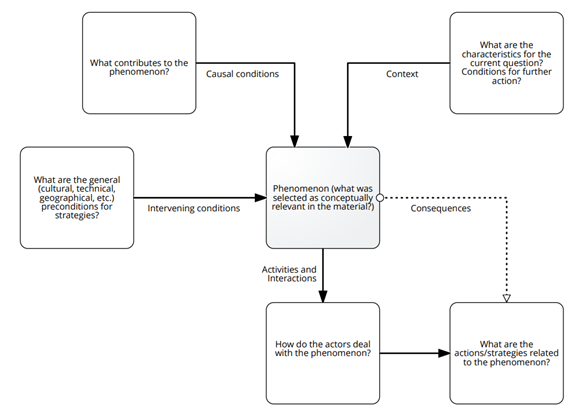
The coding process forms the centrepiece of grounded theory by supporting the transformation from raw material to theory. The method comprises three main phases of the coding process: open coding, axial coding, and selective coding. These phases build on each other and aim to transform the raw data into a comprehensive theory (Strauss & Corbin, 1996). Open coding is the first phase and involves segmenting the data into smaller units that are relevant to the phenomenon under investigation. These units can consist of words, sentences or paragraphs and are used to develop initial concepts. By applying the comparison technique, similar events and statements are brought together to form general categories. In this study, which is based on expert interviews and company documents, categories such as data management, internal innovation processes and external collaborations were identified. An essential part of open coding is the writing of memos in which the researcher records their thoughts, interpretations and emerging theories. These memos serve as a bridge between data and theory, as they document the analytical steps and promote the reflection process (Strauss & Corbin, 1996). In axial coding, the categories developed during open coding are further specified and placed in relation to each other. The aim is to understand the relationships between the categories and to develop a deeper understanding of the phenomenon under investigation. Strauss and Corbin's coding paradigm serves as a guideline here by systematically structuring elements such as causal conditions, context and consequences (Strauss & Corbin, 1996).
Figure 2: Coding paradigm according to Strauss
Source: Own illustration based on Strübing, 2014, p. 25
Grounded theory, a qualitative research method, develops theories directly from collected data without drawing on existing theories. Originally introduced by Glaser and Strauss in the 1960s, it follows an inductive, iterative process in which data is systematically collected, coded and analysed. This approach makes it possible to identify patterns and underlying mechanisms, whereby the understanding of the phenomenon under investigation is gained step by step from empirical data (Strauss & Corbin, 1996). In the present study, grounded theory was applied to the digital transformation of tkSE, using a triangulation of literature research, document analysis and expert interviews to gain a sound theoretical understanding of the factors influencing innovation ecosystems. This combination ensures theoretical sensitivity and enables realistic theory development in the context of the steel industry. An essential element of grounded theory is the iterative comparison process, known as theoretical sampling. Through this continuous comparison of new data with previous findings, theory and data continue to develop in parallel. This process, also known as ‘theoretical sampling’, allows emerging concepts and categories to be validated and refined throughout the research process by collecting data specifically to close gaps in the developed categories (Strauss & Corbin, 1996). In this study, additional expert opinions and documents supplemented the analysis to further develop the theory and ensure that the concepts were sufficiently elaborated in both breadth and depth.
For example, the study shows that external cooperation plays a decisive role in the implementation of innovation ecosystems at tkSE, while internal factors such as data management significantly influence the success of this implementation. Axial coding made it possible to analyse the links in detail, for example between the strategic decision to rely on external partners and the resulting changes in the internal innovation culture. This created a sound understanding of the dynamics of innovation ecosystems and their impact on the digital transformation at tkSE (Strauss & Corbin, 1996). In the final selective coding stage, a central theory is developed that comprehensively explains the phenomenon under investigation. In this study, the theory of ‘adaptive digital convergence’ was developed as the central theory. It describes the targeted use of innovation ecosystems to drive the digital transformation and adapt tkSE to changing technological and market-related conditions. This core category links all other categories, such as external partnerships and technological resources, and forms the anchor point of the theory. The result is a coherent theory on the strategic use of innovation ecosystems that specifically promotes innovative strength and adaptability in the digital transformation.
The research design was applied in the transfer process: The study follows a qualitative research design based on grounded theory according to Strauss and Corbin. Data collection and analysis were carried out using a triangulation of three perspectives: (1) a literature review on innovation ecosystems in the context of open innovation, (2) a document analysis of tkSE's innovation and digital strategy, and (3) twelve semi-structured expert interviews with company-wide digitalisation experts, which were conducted online via Microsoft Teams and lasted approximately 30 minutes each. ATLAS.ti software was used to support the systematic evaluation, with the interpretation work remaining entirely with the researcher. The analysis process included open, axial and selective coding in an iterative procedure with theoretical sampling.
4. Data Analysis and Interpretation
The analysis of the data collected provides a sound basis for assessing the importance of an innovation ecosystem for the digital transformation and innovative strength of tkSE. The results illustrate the far-reaching potential of a strategic innovation approach, particularly through the systematic use of internal and external knowledge resources and data-driven processes.
Data Analysis and Interpretation – Key Results
The analysis revealed the strategic use of data-driven decision-making for operational efficiency and competitive edge. Key findings highlighted:
1. Process Optimization: Enhanced efficiency through data-driven approaches.
2. External Collaboration: Synergies achieved via partnerships with external experts.
3. Resource Savings: Cost and time savings from targeted digital innovations.
These findings validate the ‘adaptive digital convergence’ theory, demonstrating the transformative potential of innovation ecosystems for digitalization.
A key result of the data analysis is the comprehensive optimization of company processes through the strategic use of existing data. This shows that data-driven decision-making processes enable significant increases in efficiency in production and administrative processes. The analysis emphasizes that existing company data represents untapped potential that can be exploited through precise analysis and application methods. Concrete progress was achieved by accelerating operational processes and more precise process design. The data shows that targeted measures have not only improved operational efficiency, but also strategic decision-making capabilities.
Another key aspect of the analysis concerns the involvement of external players and the resulting synergy effects. The data shows that collaboration with external partners and experts is essential in order to identify technological trends at an early stage and efficiently integrate innovative solutions into existing processes. These findings support the theory of “adaptive digital convergence”, which emphasizes the importance of integrating internal and external sources of knowledge for companies' ability to innovate. It is particularly striking that these collaborations not only led to technological progress, but also triggered a cultural change within the organization. The interdisciplinary collaboration fostered by these partnerships contributed significantly to the culture of innovation and increased the company's agility in dealing with dynamic market changes.
A third key finding of the analysis is the effect of targeted digital innovations on resource savings. The results show that significant savings in time and costs were achieved through the implementation of digital solutions. These savings were used to create scope for the development and implementation of cutting-edge technologies. The data findings show that these technologies not only strengthen current competitiveness, but also create the basis for long-term market leadership in the global steel industry. This represents a key strategic advantage, particularly in a traditionally capital-intensive and competitive sector such as steel production.
The analysis confirms the hypothesis formulated at the beginning that innovation ecosystems play a key role in overcoming the challenges of digital transformation and increasing competitiveness. The systematic use of internal and external knowledge resources allows companies such as tkSE not only to react flexibly to dynamic changes, but also to proactively tap into new market opportunities. The empirical results underpin the theory of “adaptive digital convergence” and expand it with concrete practical application examples. This theory shows how the integration of resources and knowledge can not only accelerate innovation processes, but also create strategic freedom for future developments.
The results of the analysis provide valuable implications for the strategic orientation of management. In order to fully exploit the potential of an innovation ecosystem, it is necessary to create a balance between internal competencies and external sources of knowledge. The data suggests that a stronger focus on data-based decision-making processes and continuous cooperation with external partners will lead to increased competitiveness in the long term. At the same time, it is emphasized that these strategic measures must be accompanied by an innovation-friendly corporate culture in order to promote the acceptance and implementation of new technologies.
Figure 3: Research Insights at a Glance
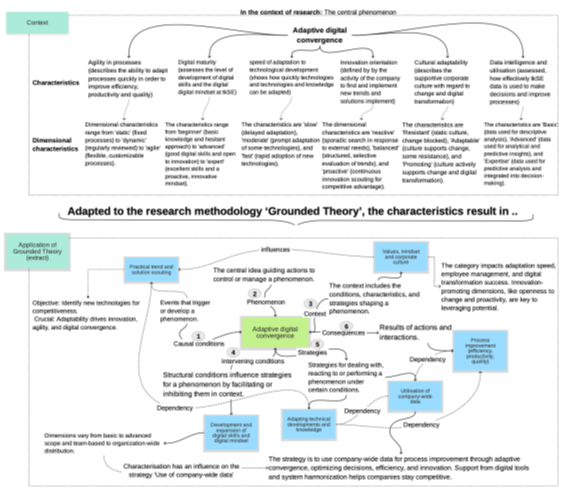
Source: Own illustration
In summary, the central finding of the analysis is the concept of ‘adaptive digital convergence’, which describes continuous adaptation and further development within the context of digital transformation. It emphasises the need to make internal processes more efficient, productive and high-quality through constant optimisation. At the same time, the focus is on expanding digital skills and a digital mindset in order to adapt flexibly to technological developments and external knowledge. The concept also underscores the crucial role of external partners in practical trend and solution scouting and in the implementation of innovative approaches. Values, corporate culture and the use of company-wide data are further key factors that interact with the core category. Through this holistic approach, adaptive digital convergence enables the dynamic networking of technological, cultural and organisational elements that specifically drive digital transformation at tkSE.
5. Conclusion and Recommendations
The study of the digital transformation at tkSE impressively shows that innovation ecosystems play a central role in strengthening the company's innovative strength and competitiveness. The theory of “adaptive digital convergence” developed as part of this study provides in-depth insights into the mechanisms by which innovation ecosystems contribute to digital transformation. It becomes clear that the strategic use of knowledge from internal and external sources and the targeted use of digital technologies are key success factors. Innovation ecosystems enable tkSE to identify technological trends at an early stage, use them efficiently and thus sustainably increase its innovative strength.
A key finding of the study is that mere participation in an innovation ecosystem is not enough to exploit its full potential. A targeted strategic orientation and proactive operational implementation are crucial. This requires an open corporate culture that promotes the exchange of knowledge and innovation, a high level of digital maturity and a willingness to actively respond to change. Although building an innovation ecosystem in more traditional industries such as steel production can be time-consuming and resource-intensive, it offers significant long-term benefits. It not only creates sustainable competitive advantages through process optimization and the targeted use of new technologies, but also secures the future viability of the company. It is particularly noteworthy that tkSE has already made significant progress, for example through the use of technologies such as machine learning and the Microsoft Power Platform, as well as through the introduction of agile formats such as digital labs and regular innovation days.
Overall, it is clear that tkSE is on a clear and future-oriented path by continuously driving digital innovation and strengthening the company's competitiveness in the long term.
Recommendations
Based on the findings, several specific recommendations for action can be derived that are essential for tkSE in order to drive forward the digital transformation and increase the company's innovative strength. Firstly, tkSE should make targeted investments in digital development by introducing modern technologies and continuously training its employees. A high level of digital maturity is essential in order to fully exploit the potential of an innovation ecosystem. Secondly, the corporate culture should be specifically geared towards openness and innovation. By promoting interdisciplinary teams and creating space for creative ideas, a culture can be established that supports both internal and external innovation impulses.
Conclusion and Recommendations – Key Results
Innovation ecosystems are vital for overcoming digital transformation challenges and enhancing competitiveness. This study’s findings offer practical insights for tkSE and similar organizations. Recommendations include:
• Investing in modern technologies and employee training.
• Promoting an open, innovation-oriented corporate culture.
• Strengthening external partnerships for early trend identification.
• Leveraging data analytics for operational improvements.
By adopting these strategies, tkSE can secure long-term competitive advantages and lead the steel industry’s digital transformation.
In addition, the strategic integration of external partners and experts should be intensified in order to identify technological trends at an early stage and develop innovative solutions. The systematic use of company data to optimize processes is another key starting point. With the help of modern analysis tools and data-based decision-making processes, tkSE can achieve efficiency gains and use resources more effectively. Finally, long-term investment in cutting-edge technologies and the maintenance of networks should be a priority. The establishment and continuous development of an innovation ecosystem are long-term projects that can secure sustainable competitive advantages.
The research results not only broaden the perspective of open innovation research, but also offer valuable practical approaches on how data-driven transformations can be successfully implemented in traditionally characterized industries. The targeted use of knowledge exchange and data-based approaches will sustainably strengthen the adaptability and competitiveness of companies such as tkSE.
Conclusion
The digital transformation presents tkSE with major challenges, but at the same time opens up immense opportunities. The study shows that a purposefully developed and strategically utilized innovation ecosystem can enable the company not only to master the challenges of digital transformation, but also to secure sustainable competitive advantages. The decisive factors for success are consistent strategic implementation, continuous adaptation to technological developments and the targeted use of data and external resources.
tkSE has already created a solid foundation by making pragmatic use of digital technologies, entering into partnerships with leading technology providers and strengthening internal innovation processes. With a clear focus on improving digital maturity, building an open innovation culture and strategically leveraging external resources, the company has the opportunity to not only increase its innovation power, but also take a leading role in the steel industry. The results of this work not only provide valuable impetus for practical implementation, but also offer tkSE a clear guide on how to accelerate the digital transformation and make it a lasting success.
The study shows that innovation ecosystems play a central role in the digital transformation and competitiveness of tkSE. At the same time, it highlights that implementation in a traditional industry such as steel production presents specific challenges. High resource costs, long implementation periods and organisational resistance within established structures make change difficult and require consistent support from management. In addition, sector-specific requirements, such as strict safety and quality standards, present additional hurdles that can hinder innovative approaches. Dependence on external partners offers opportunities, but also risks, for example with regard to data protection and loss of know-how. Likewise, the technical integration of new digital solutions is complex and presents companies with personnel and systemic challenges.
These limitations make it clear that digital transformation is a long-term, iterative process that requires not only technological investments but also structural adjustments and an open corporate culture. Only by taking a realistic and holistic view of these factors can tkSE achieve sustainable competitive advantages and strengthen its innovative power in the long term.
Despite these sector-specific hurdles, strategic engagement with innovation ecosystems remains essential for tkSE. They enable the effective networking of internal and external knowledge sources, the early identification of technological trends and their rapid implementation in marketable solutions. This not only strengthens the company's innovative power, but also secures its leading role in the steel industry in the long term.
References
Blog – Megatrend Konnektivität. (n. d.). https://www.zukunftsinstitut.de/blog-megatrend-konnektivitaet
Bohnsack, R., Flick, U., Lüders, C., & Reichertz, J. (2014). Qualitative Sozialforschung (3rd ed.). Springer Fachmedien Wiesbaden GmbH.
Chesbrough, H. W. (2003). Open Innovation: The New Imperative for Creating and Profiting from Technology. https://amp.aom.org/content/20/2/86.abstract
Disselkamp, M. (2012). Innovationsmanagement. Springer. https://doi.org/10.1007/978-3-8349-4472-6
Haase, I. (2018). Kommunikation in Open Innovation-Prozessen von kleinen Unternehmen. Springer. https://doi.org/10.1007/978-3-658-23822-3
Hartlieb, E., Kandolf, T., Kanzian, R., & Roth, M. (2018). Aufbau von Innovationskooperationen im Kontext von Industrie 4.0 und IoT. Springer (pp. 1–13). https://doi.org/10.1007/978-3-658-11667-5_1
Hoffecker, E. (2019). Understanding Innovation Ecosystems: A Framework for Joint Analysis and Action. Massachusetts Institute of Technology.
Kowalski, M. (2018). Management von Open-Innovation-Netzwerken. Springer. https://doi.org/10.1007/978-3-658-20907-0
Mattes, R. M. (2022). Gesunde Führung in der VUCA-Welt: Leadership in Transformation. Haufe-Lexware.
Mehner, B. (2022). Open Innovation: Erhöhung des kreativen Potenzials durch die Öffnung von Innovationsprozessen. Springer (pp. 157–173). https://doi.org/10.1007/978-3-662-63117-1_9
MIT Practical Impact Alliance, MIT D-Lab, Hoffecker, E., & MIT Practical Impact Alliance. (2019). Understanding Innovation Ecosystems: A Framework for Joint Analysis and Action. MIT Practical Impact Alliance.
Obermaier, R. (2019). Handbuch Industrie 4.0 und digitale Transformation. Springer. https://doi.org/10.1007/978-3-658-24576-4
Roland Berger Strategy Consultants & BDI. (n. d.). DIE DIGITALE TRANSFORMATION DER INDUSTRIE. Roland Berger Strategy Consultants / BDI.
Reichwald, R., & Piller, F. (2009). Interaktive Wertschöpfung. Gabler. https://doi.org/10.1007/978-3-8349-9440-0
Schäffer-Poeschel, R. (2023, April 13). Neue Methoden für mehr Innovation. Schäffer-Poeschel. https://www.schaeffer-poeschel.de/innovationsoekosysteme-neue-methoden-fuer-mehr-innovation/
Strauss, A. L., & Corbin, J. M. (1996). Grounded Theory: Grundlagen qualitativer Sozialforschung.
Strübing, J. (2014). Grounded Theory – Zur sozialtheoretischen und epistemologischen Fundierung eines pragmatistischen Forschungsstils. Qualitative Sozialforschung (3rd ed.). Springer Fachmedien Wiesbaden GmbH.
Wiener, M. (2018). Open Foresight und Unternehmenskultur: Organisationskulturelle Voraussetzungen für die Zukunftsfähigkeit von Unternehmen. Springer.